Booking a trip in 2026 means juggling fares, refundability rules, visa eligibility, hotel cancellation windows, lounge access, ground transfers, restaurant tables, and a working SIM — across about a dozen open tabs. An AI concierge for travel is the layer that makes that whole stack disappear into one conversation. Not a chatbot that suggests “maybe try Skyscanner”; an agent that plans the trip, books it on your card, and keeps watching the itinerary after you have closed the laptop.
§Verdict
The reason this matters now, in 2026, is that the underlying agent runtimes are finally good enough to keep state across a multi-day plan without losing the thread.
01How an AI concierge plans a trip
The mental model is short. You give the concierge a goal in plain English; it turns that into a draft itinerary; you push back on the parts you do not like; it reprices and rebooks; you confirm the spend; it executes. One short session for a domestic weekend, roughly three back-and-forths for a longer trip with multiple cities.
Where older travel tools surfaced a hundred options and asked you to choose, an AI concierge does the inverse. It reads your preferences, applies the constraints you forgot to mention (no red-eyes back, hotel within fifteen minutes of the venue, room with a desk for working), and surfaces three options with the trade-off named on each one. The piece on best AI concierge apps in the UK for 2026 walks through which products are doing this credibly.
02What you actually tell it
The first conversation matters more than any later one. A travel concierge that knows you well behaves like a human assistant who has booked you a dozen times. The information it needs to be that good lands in roughly four buckets.
1. Identity
Passport details, frequent-flyer numbers, hotel loyalty programmes, dietary needs, accessibility preferences, billing card. One pass, stored in scoped vaults.
2. Preferences
Aisle or window, hard limits on connection times, hotel categories, neighbourhoods you like, restaurant style, ground-transfer rules, mobile data needs.
3. Calendar
What is fixed, what is fluid, who else is on the trip, the meetings that anchor the dates, the days you cannot be in the air.
4. Budget
A single number per trip is fine. Better is a soft envelope (“mid-range hotel, business class only on flights longer than seven hours”).
From the second trip onward, none of this is asked again. That is the difference between an AI concierge and a search engine with a chat skin: continuity. The system remembers that you stopped staying at a particular chain after a bad night in Berlin, and it stops surfacing them.
03Plan, act, observe, replan
Underneath the conversation, the concierge runs the agent loop that has become standard in 2026. It is the same loop a developer would write by hand on top of a frontier model, but productised.
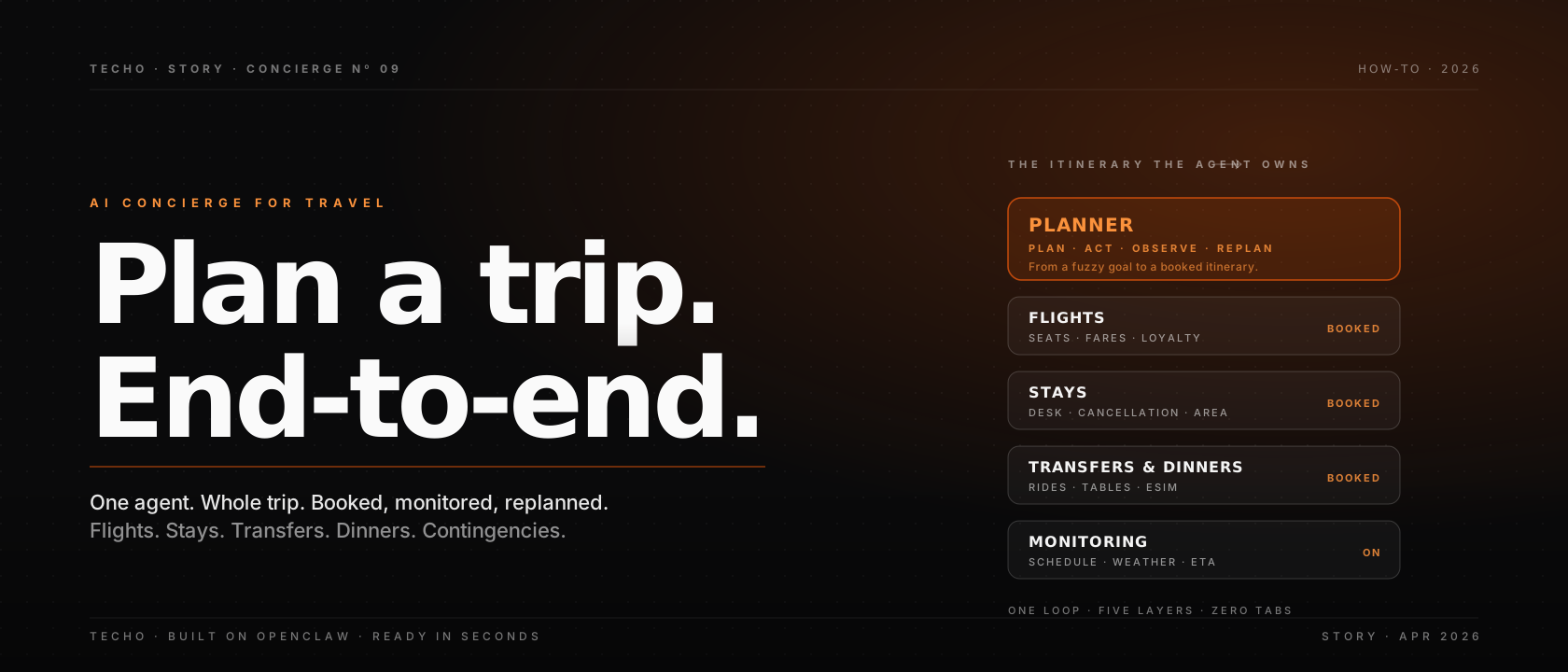
Plan. The agent decomposes “four nights in Lisbon, working from the hotel, two dinners” into ranked sub-tasks: outbound flight, return flight, hotel matching the working-from criteria, two restaurant slots, ground transfers, eSIM, lounge eligibility check, calendar block.
Act. For each sub-task it calls a real tool: airline GDS, hotel inventory APIs, OpenTable / Resy / SevenRooms equivalents, eSIM marketplaces, your calendar. The calls are typed contracts with retries, not free-form prompts hoping for a good string back.
Observe. It collects the responses, flags conflicts (two dinners on the same night), notices the cheaper redeye that violates your no-red-eye rule, and weighs trade-offs against your stored preferences before showing you anything.
Replan. If a hotel falls through or a flight is rerouted, the loop runs again with the updated state. You do not retell the story; the agent already has it.
04The tools it talks to
An AI concierge is only as good as the tools it can call. A useful travel concierge in 2026 talks to roughly seven categories of system on your behalf, with credentials scoped per call.
- Flight inventory. Airline APIs, GDS providers, low-cost carriers; refundable vs basic, baggage rules, seat maps.
- Hotel inventory. Chain APIs, aggregators, boutique aggregators; loyalty matching, cancellation windows, room types.
- Ground transfers. Ride-hailing, airport transfer brokers, train operators; SLA windows for early-morning departures.
- Restaurants. The big reservation platforms plus direct restaurant systems; the playbook is in how to book a restaurant without calling.
- Documents. Visa eligibility checkers, passport-validity rules, vaccination status registries.
- Connectivity. eSIM marketplaces with regional packages; activation timed to landing.
- Itinerary monitoring. Schedule-change feeds, weather, ground-transport disruption alerts.
Each tool sits behind a typed interface, so the agent cannot improvise when an API returns something unexpected. That sandboxing is what turns a clever demo into something safe to point at your real card and your real passport.
05Where it shines, and where it does not
Honest framing matters, because nothing erodes trust faster than a travel concierge that overpromises on corner cases.
Where it wins clearly. Repeat travel patterns (founders flying the same triangle every fortnight), multi-leg itineraries with constraints, monitoring after booking, the boring “am I eligible for this lounge / does this card cover this insurance” layer, and dinner reservations across cities you do not know.
Where a great human still wins. Bespoke high-touch travel where the value is relationships at the property; truly novel destinations where local knowledge is sparse online; complex insurance-and-medical interactions; and long-form planning where a phone call with someone who has been there is faster than any agent.
Where neither wins. Spontaneous travel that is the point of leaving plans behind. A good concierge will quietly admit when there is nothing useful to optimise.
06On the day of travel
The booking moment is only the first half of what a travel concierge owns. The second half is the part that quietly removes most of the stress: monitoring the trip and acting on changes.
A working setup keeps a subscription on every leg of your itinerary. When a flight is cancelled, the agent has already drafted the rebooking by the time you see the airline notification. When a hotel oversells your room, it has the alternative cued up. When ground-transport ETAs slip past your departure window, it pings you with a recalculated leave-by time and an alternative.
None of that is glamorous; all of it is what the previous generation of “AI travel” tools could not do because they had no continuous loop. The shift from one-shot to monitored is the shift from a tool that helps you book to a concierge that owns the trip.
07AI concierge vs travel agent vs DIY
The honest grid for a 2026 traveller making the choice for the first time. The answer is rarely binary; many people use a concierge for the eighty per cent and a human for the rare bespoke trip.
| Criterion | AI concierge | Human travel agent | DIY |
|---|---|---|---|
| Speed to itinerary | Minutes | Days | Hours |
| Cost | £19–99 / mo, unlimited | Per-trip fee + markup | Free, ex. your time |
| Memory across trips | Yes, persistent | Partial, depends on agent | Your spreadsheet |
| Monitoring after booking | Continuous | Office hours | You |
| Bespoke high-touch | Limited | Strong | Limited |
| Local knowledge | Good in major cities | Strong where the agent specialises | Variable |
| Best for | Frequent and mid-complexity travel | Bespoke, once-a-year trips | One-off, low-stakes travel |
For a deeper read on the human-vs-AI side of the same question, the piece on AI personal assistant vs human PA walks through the same trade-off applied to admin more broadly.
☰Cheatsheet: AI concierge for travel
One scannable grid for keeping the categories straight:
| Question | Answer |
|---|---|
| Category | AI concierge, travel vertical |
| Owns the outcome | Yes — books, monitors, replans |
| Memory | Persistent: passport, loyalty, preferences |
| Tools called | Flights, hotels, transfers, restaurants, eSIM, calendar |
| Spend confirmation | Required for non-trivial bookings |
| Monitoring | Schedule changes, weather, transport, hotel issues |
| Cost shape | £19–99 / mo subscription, unlimited trips |
| Best fit | Frequent and mid-complexity travel |
| Honest weak spot | Bespoke high-touch, long-tail destinations |
?FAQ
Does an AI concierge actually book travel, or just suggest options?
A capable AI concierge does both. It produces a shortlist with prices and trade-offs, asks for the call you cannot delegate, then completes the booking on your card with your loyalty numbers attached. The pattern that works in 2026 is plan autonomously, confirm the spend, then act — rather than handing you a list and walking away.
Will the AI use my real preferences or generic ones?
It uses yours, provided the concierge has persistent memory. The first trip teaches the system that you prefer aisle seats on long-haul, dislike connections under sixty minutes, and only stay in hotels with proper desks. From the second trip onward those preferences become defaults rather than questions, which is why a memory-backed concierge gets sharper over time.
Can it handle the messy stuff — visas, lounges, transfers, refunds?
The strong ones cover roughly eighty per cent of it. Visa eligibility and document checks, lounge access via card or status, ground transfer windows, refundable-vs-non-refundable trade-offs, schedule-change rebooking. The remaining twenty per cent is genuine human territory: bespoke embassy appointments, escalations to airline call centres, last-minute cash decisions in unfamiliar currencies.
What happens when a flight is cancelled at three in the morning?
A travel concierge with monitoring on stays subscribed to your itinerary across the major data feeds. When a cancellation hits, it drafts the rebooking, ranks the alternatives, and either rebooks under a pre-agreed envelope or pings you with one tap to approve. The time you save is not the booking minute; it is the hour of triage at the airline desk.
Is an AI travel concierge cheaper than a human travel agent?
By an order of magnitude for the same scope. A human travel agent typically charges a planning fee plus a per-booking fee, often plus a markup; an AI concierge subscription sits in the £19–99 per month band for unlimited trips. The trade-off is judgement on bespoke high-touch travel, where a great human still wins on relationships and local knowledge.
Is my passport and card data safe with a travel agent built on AI?
On a serious platform, yes. Document and payment data sit inside scoped vaults, are decrypted only at the moment of use, and tool calls run in sandboxes that cannot exfiltrate credentials sideways. Anything that books on your behalf should publish its data residency, retention, and audit posture; if it does not, treat that as the answer.
§Where Techo fits
Techo is a productised, ready-to-use AI concierge built on OpenClaw — the open-source agent engine. The travel surface uses the same loop covered above: plan from your preferences, call the right tools to act, hold the trip in persistent memory, watch the itinerary, replan when something moves. The point of building on OpenClaw rather than rolling our own runtime is that the boring infrastructure (memory, sandboxes, tool routing, observability) is solved upstream, so the work goes into the travel logic and the user interface.
If you want to try the concierge end of the surface, Techo's AI concierge is the place to start; the engine underneath is the same OpenClaw the open-source community runs, with the operations layer managed for you.
A good travel concierge is not the one that surfaces more options. It is the one that quietly turns “four nights in Lisbon” into a booked trip you do not have to think about until you are at the gate.
The category is finally good enough to deserve a place in the way independent travellers organise their year. The right yardstick in 2026 is no longer “does it find a cheap fare” — that is table stakes — but “does it own the trip after the booking, and does it remember you next time.” If the answer to both is yes, you have a concierge; if not, you still have a search engine.