The question is older than 2026, but the answer changed last year. Until recently, anyone serious about reclaiming time hired a person. Now a well-wired AI personal assistant handles a large slice of the same work — for the price of a gym membership. Here is the comparison written by someone who has hired both, broken into the five axes that actually matter: cost, speed, memory, judgement, and trust.
We build Techo — an AI concierge on top of OpenClaw — so we are not neutral. Where AI genuinely loses to a human, this piece says so plainly. The goal is a decision you will not regret in six months, not a sales page.
§The one-line answer
Everything that follows is the long version of that sentence, with the maths, the edge cases, and the six questions that decide which way you should tilt.
01These are not the same hire
Most comparisons fail because they treat "AI personal assistant" and "human PA" as direct substitutes. They are not. They are two different hires, with an overlapping but not identical job description. Sort that out first and the decision gets easier.
A human PA is hired to be a second operator on your life: to absorb inbound, filter it, prioritise it, and act as you when you cannot. The job description is heavy on discretion, phone calls, in-person presence, and relational memory about the people you interact with.
An AI personal assistant in 2026 is hired to absorb the machine side of your life: the tabs, the forms, the spreadsheets, the portals, the renewals, the research, the follow-ups that can be done with text and an API. It is superb at volume and consistency, and increasingly competent at end-to-end tasks that used to need a person on the other end of a phone.
Ai PA is great at
Research, bookings, form-filling, scheduling, inbox triage, renewal tracking, expense reconciliation, drafting, summarising, chasing.
Human PA is great at
Difficult phone calls, in-person errands, negotiating with another person, reading a room, representing you in tone, managing other people on your behalf.
Keep this frame in mind. "Which is better" is the wrong question. "Which is cheaper for the bit I actually need" is the right one.
02The 2026 cost maths, UK edition
Raw numbers first. Adjust for your own situation after.
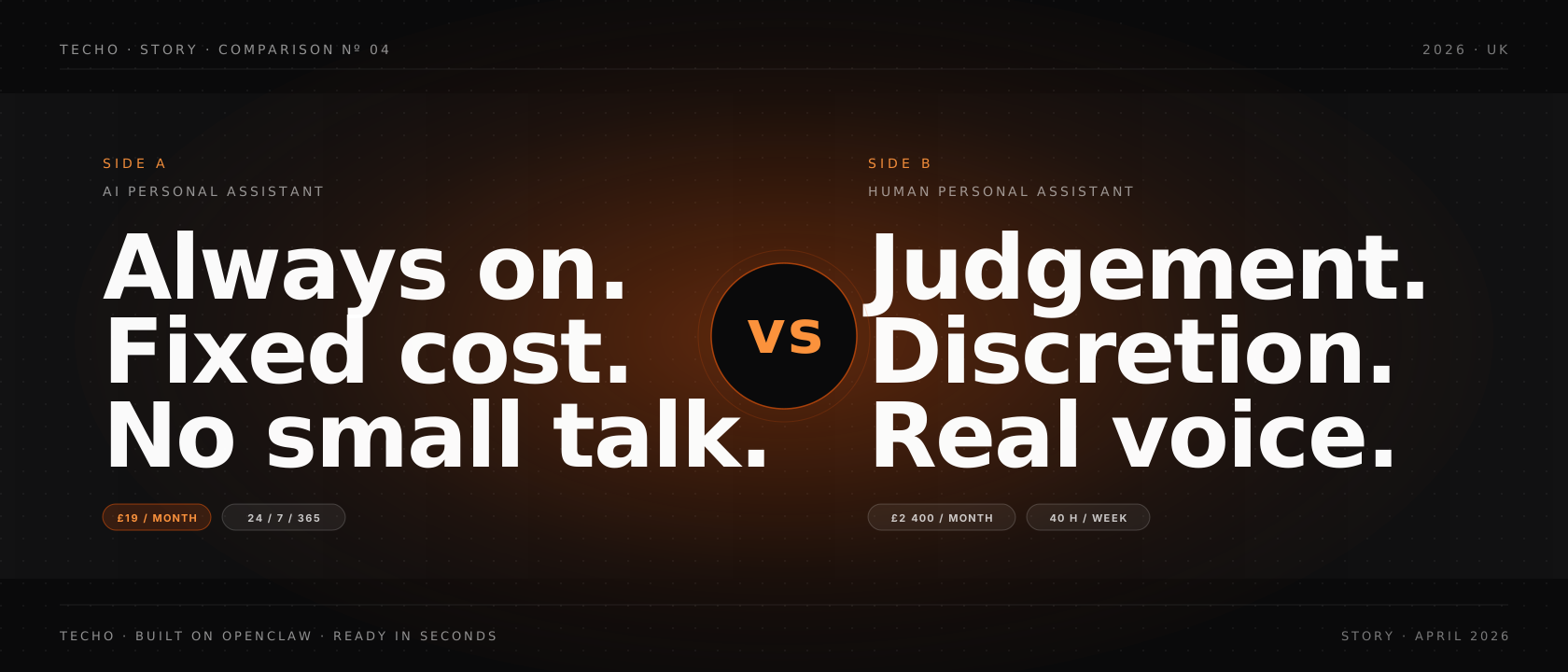
Full-time in-house PA, London: around £45 000 salary. Once you add employer NI (~£5 600), pension (~£1 400), holiday cover, a laptop, a phone, and the overhead of being someone's employer, the loaded cost is ~£55 000 to £65 000 per year — roughly £4 600 – £5 400 per month. Double that for a City-level executive PA.
Part-time remote virtual PA in the UK: £28 – £55 per hour, with most individuals buying 10 – 40 hours a month. Call that £280 – £2 200 per month, depending on how much you use. Good agencies charge more; cheap agencies do less.
AI personal assistant, consumer tier: £15 – £40 per month for something you drive. £40 – £120 per month for something with deeper integrations, memory, and human fallback. Techo's concierge tier sits around £19 per month for the individual plan.
DIY agent platform: £0 – £80 per month of raw model cost if you run OpenClaw or similar yourself, plus the time to set it up. If you are technical and enjoy the wiring, this is the cheapest. See OpenClaw vs ChatGPT agents for what the underlying engines actually cost and do.
03Speed and throughput
A human PA has one head and eight useful hours in a day. Inside those hours they are fast at email, average at research, and slow at anything that requires reading long documents or comparing 12 products across four websites.
An AI personal assistant runs many tabs at once. It will research a supplier shortlist in 90 seconds, draft five options, and have them in your inbox before a human PA has finished their coffee. For anything that is parallelisable — reading, comparing, summarising, drafting — the speed gap is not a gap. It is a different sport.
Speed caveats that matter:
- Depth beats throughput for the hard 10 per cent. When a task needs someone to sit with one phone call for 25 minutes and negotiate, speed is irrelevant. A human wins.
- Latency on external systems is external. An airline's website will take the same five minutes to refund a ticket whether a human or an AI is clicking. AI wins on the time before that click; the click itself is not magic.
- "Always on" is not the same as "always right". AI never sleeps, but an overnight task running without oversight on a booking it misread is worse than nothing. Give it guardrails.
04Memory and continuity
A human PA who has worked with you for two years is a library. They remember that you hate the Heathrow Express, that your daughter's school finishes early on Fridays, that your favourite suit is at the dry cleaner on Marylebone High Street. That memory is the core of the job.
An AI personal assistant in 2025 had almost none of that. An AI concierge in 2026 does — if it is built on the right foundation. The difference is a structured, editable profile of your preferences, relationships, and active projects, persisting between sessions. Not a vague "notes file" — a proper memory.
Where the AI still trails a human:
- Implicit context. A human reads your tone on Monday morning and adjusts. AI needs you to say it.
- People memory. A human remembers that Rachel at the venue is easy and James at the venue is not. AI is getting there, but it is not a substitute for a colleague who has met someone.
- Year-over-year nuance. A human who planned your last three birthdays has accumulated craft. AI has logs.
Where the AI beats a human flat:
- Never forgets a deadline.
- Never loses a password.
- Never sighs when you add a 12th item to the list.
- Has the whole of your preferences available in milliseconds, not after a holiday handover.
05Where a human PA still wins
This section is the one that gets skipped in bad comparisons, so it goes here in the middle rather than at the end. These are the zones where a human is not just "nicer" — they are genuinely better at the job in 2026.
- Awkward phone calls. Cancelling something. Complaining. Chasing a refund from a difficult operator. Negotiating a late fee. AI can do polite-and-persistent; a human can do polite-and-persistent with the right amount of edge.
- In-person errands. Collecting a parcel, dropping off a suit, checking on the flat while you are abroad. AI is not yet corporeal. Couriers and concierge networks are the stopgap, but they break.
- Representing you as a person. When someone needs to believe they are speaking to your office, a human does that. A polite AI on the phone — even a very good one — is still not the same signal.
- Reading a room. Finding out why a supplier has gone cold, whether a collaborator is upset, whether a venue is lying about availability. Social inference at the human level remains human work.
- Messy ethical calls. Should you attend the funeral, move the meeting, take the money? An AI will give you an answer; a human PA will recognise that you are asking the wrong question and say so.
The right frame is not "AI or human". It is "AI for the 90 per cent, a human for the 10 per cent where judgement or presence cannot be delegated to software."
06Privacy, trust, and legal exposure
A PA of either kind sees your calendar, your inbox, your payments, your relationships. That is the price of the job. How you handle the risk differs.
With a human: NDA, contract, references, probation. The failure mode is personal — a leak, a grudge, a careless comment at the pub. Recourse is legal. Employer liability is real.
With an AI: a privacy policy, an encryption story, a data residency claim, a vendor contract. The failure mode is systemic — a bug, a prompt injection, a model provider breach, an over-eager tool call. Recourse is contractual and, honestly, limited today.
What matters in 2026:
- Read the data policy before you connect anything. Especially payments, email, and calendar. Reputable AI PAs name their hosting, their retention window, and their training-data opt-out in plain language.
- Demand a human-in-the-loop on irreversible actions. Paying, sending, signing, posting. If the assistant can do these without confirmation, the privacy policy is not your biggest problem.
- UK context: GDPR is on your side. If a vendor cannot answer a DSAR within 30 days, that is a signal. Same for sub-processor disclosure.
07When to hire a human PA in 2026
Short list. You want a human when:
- You spend more than 25 hours a week on delegatable work, not 5.
- Your admin is primarily relational — you run teams, manage a board, have a family office, keep a property portfolio, or your reputation with named people matters weekly.
- You regularly need someone physically present — errands, travel ops, venue checks, household logistics.
- You are comfortable being an employer: salary, taxes, reviews, holiday, sick pay, the whole thing.
- Your work demands representation: a voice on the phone, a face in a meeting, a signature on a document that requires a warm-blooded signatory.
If fewer than two of those fit, a human PA is probably not the next step. If four or more fit, hire — and pair with AI for the transactional layer.
08When the AI personal assistant is the right call
You want AI when:
- You lose 3 – 15 hours a week to admin — the sweet spot that a human hire cannot justify and doing-it-yourself is visibly killing you.
- Your work spans many tools: calendars, email, booking sites, forms, banking, healthcare portals, government portals. Humans are slow at this; AI lives there.
- You travel or move between cities and a local human PA cannot follow you.
- You want predictable fixed cost rather than a salaried hire.
- You are allergic to being an employer. You are not wrong; it is a job.
- Your admin is transactional — bookings, renewals, research, follow-ups — with only occasional need for human judgement.
If three or more fit, an AI PA is the obvious next step. If none fit, stop reading — you are in the rare category where DIY still makes sense.
09The hybrid model — the honest 2026 answer
Every version of this piece written by someone with both hires ends up in the same place: AI does the 90 per cent, a human covers the 10 per cent. The ratio moves each year; the shape does not.
What the hybrid actually looks like in practice:
- AI owns the default. It lives inside your email, calendar, bookings, forms, banking, and portals. It is your first line for anything transactional. It runs 24/7 on a fixed fee.
- A human owns the exceptions. Phone negotiation, in-person, high-stakes judgement, relational memory with named counterparties. Often part-time — four to eight hours a month — or a retainer with a trusted virtual PA.
- The AI can hand off. A good concierge-grade AI does not try to win the hard 10 per cent; it tags it, summarises it, and routes it to the human. The AI's job is to make sure the human is never surprised.
- The human can brief the AI. A three-line instruction from a human PA ("from now on, use this courier; do not book anything via that supplier") lives as a rule in the AI's memory. You build a library over months.
☰Cheatsheet: AI PA vs human PA in 2026
One table to keep the decision straight:
| Axis | AI personal assistant | Human PA |
|---|---|---|
| Cost (individual) | £19 – £120 / month | £2 400 – £5 400 / month full-time |
| Availability | 24/7/365 | Contracted hours + holidays |
| Speed on research | Seconds – minutes | Hours |
| Tools used at once | Dozens, in parallel | One at a time |
| Memory across sessions | Structured, persistent | Human long-term memory |
| Phone calls (outbound) | Simple scripts; improving fast | Any conversation |
| Negotiation, reading a room | Limited | Native strength |
| In-person errands | Via couriers only | Yes |
| Legal representation / signatures | No | Yes |
| Holiday / sick cover | None needed | Employer responsibility |
| Onboarding time | Hours – days | Weeks – months |
| Failure mode | Wrong action, confidently | Human error, sometimes personal |
| Best use | Transactional, high-volume | Relational, judgement-heavy |
?FAQ
How much does a human personal assistant cost in the UK in 2026?
A full-time, in-house PA in London in 2026 costs roughly £38 000 to £55 000 per year salary, or £2 400 to £3 800 per month loaded cost once you include employer NI, pension, holiday, and a laptop. A part-time remote virtual PA in the UK typically bills £28 to £55 per hour, with most individuals buying 10 to 40 hours a month.
Can an AI personal assistant actually book flights, restaurants, and appointments?
Yes. In 2026 a well-wired AI personal assistant books flights, restaurants, doctor and dentist appointments, logs into portals, fills forms, and pays via a card on file. It needs integrations set up, and for anything irreversible — a non-refundable booking, a payment over a threshold, a legal document — it should ask for human approval.
What can a human PA do that an AI cannot?
Pick up the phone to a difficult person, read a room, hold a relationship with someone who hates email, negotiate in person, be physically present, exercise judgement in messy ethical situations, and represent you in tone. Anything that requires being believed as a human representative of you.
Is it cheaper to hire a virtual PA or use AI?
For under about 12 hours of admin a week, a good AI personal assistant at £19 to £100 a month is dramatically cheaper than any virtual PA. Above 20 hours a week of complex, judgement-heavy work, a virtual PA starts to earn their fee. Between 12 and 20 hours, most people are best off with a hybrid: AI does the routine, a virtual PA handles the hard 20 per cent.
When should I switch from an AI PA back to a human?
When your admin becomes primarily relational — managing a team, a board, a family office — rather than transactional, and when the cost of a wrong judgement exceeds the cost of a human month. Most people never fully switch back; they add a human on top of the AI for the high-stakes 10 per cent.
What is the difference between an AI personal assistant and an AI concierge?
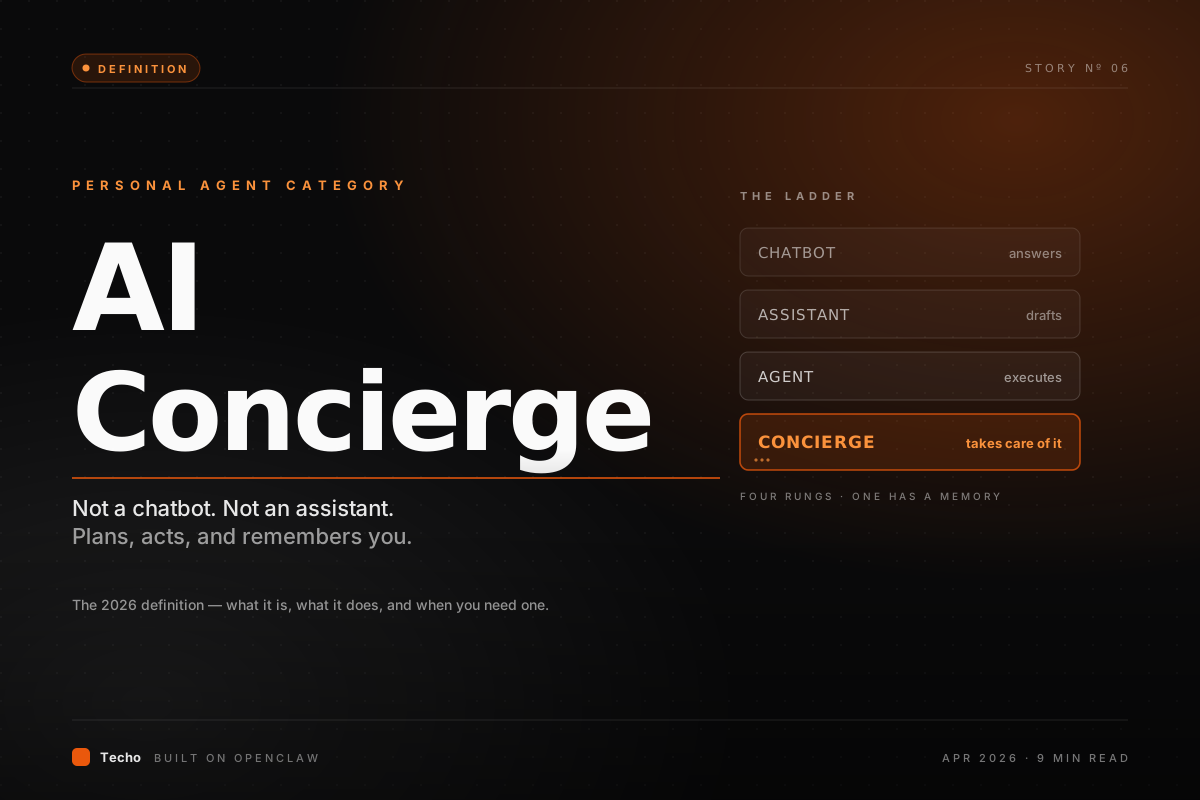
An AI personal assistant typically drafts, schedules, and answers on your behalf inside one or two tools. An AI concierge plans and executes real-world tasks end-to-end — booking, paying, following up — across many tools, and remembers you between sessions. The concierge is the higher rung, and it is where the comparison with a human PA actually becomes fair.
§Where Techo fits
If you have read this far, the decision you are making is probably not "AI or human". It is "which AI, and how do I keep my options open to add a human later?"
Techo is an AI concierge built on OpenClaw. We are the engine Techo members use to cover the transactional 90 per cent — bookings, renewals, research, follow-ups, scheduling, paperwork — with persistent memory of your preferences, a human-in-the-loop safety net on irreversible actions, and a posture that assumes you may one day bring a human PA in. If you do, your AI's memory and routines will brief them on day one. Try it at techo.ai and see if it takes 10 hours back this month.
The honest sentence to end on: most people in 2026 do not need a human PA. They need a credible AI personal assistant that acts like one — and a small, part-time human for the 10 per cent where software still loses. Choose in that order, and you will not regret the decision in six months.