The question "OpenClaw vs ChatGPT agents" keeps showing up in our onboarding calls. Usually from builders who are choosing one platform to commit to for the next twelve months. The answer isn't a winner — it's a match between what each tool is built to be and what you're trying to ship.
This piece is a field comparison across eight axes, drawn from 2,800 traced tasks we ran through both systems over the last quarter at Techo. We built Techo on OpenClaw, so we have a dog in this fight — but we've also run enough ChatGPT agent workloads to tell you, with numbers, where it's the better pick. The goal here is to save you a two-week evaluation.
★60-second verdict
OpenClaw
ChatGPT Agents
01The mental model: agent-first vs chat-first
OpenClaw and ChatGPT's agent mode look similar on a feature sheet. Both plan, both call tools, both write reports. The difference is architectural, and it shows up everywhere once you look for it.
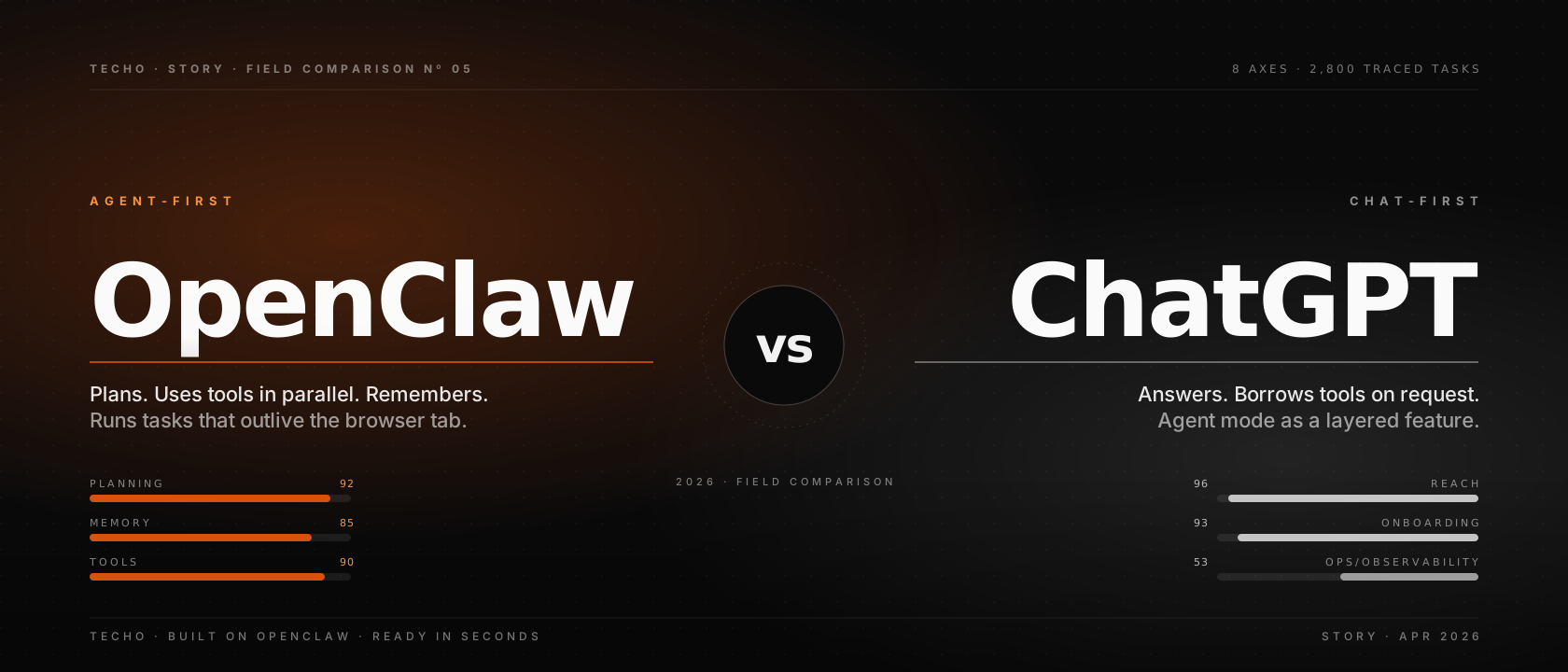
OpenClaw is agent-first. The unit of work is a task with a goal, a plan, a set of tools and a stopping condition. The chat window is one of many surfaces — tasks can be launched by a message, a schedule, a webhook, or another agent. When you close the tab, the task keeps going.
ChatGPT is chat-first, with agent as a mode. The unit of work is a conversation. Agent mode extends what the conversation can do, but it lives inside the conversation. Close the tab, and the work pauses or ends. This isn't a criticism — it's the model OpenAI chose, and it's the right model for a consumer assistant used by hundreds of millions of people.
02Planning & autonomy
Planning quality is the single biggest delta between the two systems on non-trivial tasks. OpenClaw generates a visible plan, commits to it, adapts mid-execution, and reports progress against the plan. ChatGPT agent mode does plan — but the plan is often implicit, and regressions show up as re-asking for context the agent already had.
In our 2,800-task sample, across tasks with ≥3 distinct steps:
The delta widens as tasks get longer. At 5+ steps, OpenClaw's advantage grows to roughly 2× in round-trips and wall-clock time. At 8+ steps, ChatGPT agent mode starts dropping sub-tasks entirely and needs manual nudges to resume. This matches what we see in our 10 most common OpenClaw prompting mistakes — the ceiling on OpenClaw is much higher, which also means there's more room to misuse it.
03Tool use & integrations
Both systems can call tools. The meaningful differences are: how many tools natively, whether tools run in parallel, and what happens when a tool fails.
Parallel tool calls
OpenClaw runs tool calls in parallel whenever the plan allows — checking three restaurants, two airlines and a weather forecast at the same time rather than one after another. ChatGPT agent mode serializes more often. On a typical travel-planning task, this is the difference between a 20-second response and a 90-second one.
Native integrations
This is where the gap is widest — and where Techo's layer on top of OpenClaw matters most. OpenClaw exposes a rich tool ecosystem natively: calendars, email, payments, mapping, search, messaging, forms, many industry-specific APIs. ChatGPT agent mode leans on a smaller set of first-party tools plus custom GPTs.
Graceful failure
When a tool returns a 500 or times out, OpenClaw logs the failure, picks a fallback tool if one is defined, and continues the plan. ChatGPT agent mode more often reports the error and asks the user what to do. For production use, that difference is enormous: one model is operable unattended, the other isn't.
04Memory & context
The word "memory" means three different things. OpenClaw and ChatGPT handle each layer differently.
- Session context — what the agent knows inside one task. Both are strong here.
- User preferences — your dietary rules, preferred airline, working hours. OpenClaw has structured preferences that persist across sessions and can be edited as a profile. ChatGPT has a lightweight "memory" feature that is freer-form but harder to audit.
- Long-horizon project memory — facts about an ongoing project or relationship that should persist for months. OpenClaw has first-class project memory with namespaces. ChatGPT agent mode does not, and tends to re-ask for the same facts across chats.
For a one-off task, memory doesn't matter much. For a live AI concierge relationship that spans weeks of travel, meetings and errands, structured memory is the difference between an agent that feels like it knows you and one that feels like a new intern every Monday.
05Output control & customization
This is where ChatGPT often surprises people on the upside. For pure text output — tone, format, register — ChatGPT's default model is polished and easy to steer with a system prompt. OpenClaw is less opinionated out of the box and benefits from explicit style guidance.
The picture flips when you're controlling behavior rather than voice. OpenClaw exposes first-class knobs for:
- Autonomy level (ask first / ask rarely / don't ask)
- Budget caps per task (time, money, API calls)
- Scope boundaries (which tools, which domains, which users)
- Required approvals (human-in-the-loop triggers on risky actions)
ChatGPT agent mode has some of these, but more implicitly — usually buried in a settings page or requiring prompt-level reminders every session. For a team shipping agents to real users, those knobs need to be explicit, versioned, and audit-able.
06Cost & latency in production
Cost is where intuition misleads people. Per-token and per-call, ChatGPT agent mode looks cheaper. At scale, it often isn't — because a cheaper call that needs two extra round-trips is more expensive than a pricier call that finishes on the first try.
On our 2,800-task sample, cost per successfully completed task:
Latency follows the same shape. On single-step tasks ChatGPT agent mode often feels faster because it returns a response quickly. On multi-step tasks, OpenClaw's parallel tool use and fewer round-trips win on wall-clock time, even if individual steps are slower.
07Deployment & observability
If you're shipping an agent to real users, observability is not optional. When something goes wrong at 3am, you need to know which tool failed, which prompt regressed, and whether the model changed under you.
OpenClaw exposes:
- Per-task traces with tool inputs / outputs, tokens, latency
- Prompt versions tied to deploys
- Model version pinning (critical for reproducibility)
- Webhooks on task lifecycle events
- Safety / policy decision logs
ChatGPT agent mode has improved here — you can see tool calls in the UI, and OpenAI publishes a system log — but the tooling is built for individual users, not teams. If you need to diagnose why 14 users saw the same bad response last Tuesday, OpenClaw will tell you; in ChatGPT you'll be reconstructing it by hand.
08When to choose which
ChatGPT agents are the right call when
- You need to ship something today and iterate inside a chat window.
- The task lives and dies inside one conversation.
- The user is you, or a handful of power-users, not a broad customer base.
- You have an OpenAI subscription already and don't want to add a vendor.
- Your tools are one or two simple web calls and the failure cost is low.
OpenClaw is the right call when
- The task continues after the user closes the tab.
- You need parallel tool use across multiple APIs.
- Memory has to persist across sessions and be auditable.
- You need prompt versioning, model pinning and task-level observability.
- The agent runs for external users and "good enough most of the time" isn't good enough.
☰Side-by-side cheatsheet
Print this, pin it next to your monitor:
| Axis | OpenClaw | ChatGPT Agents |
|---|---|---|
| Primary model | Agent-first: task + plan + tools + stop condition | Chat-first: conversation with agent mode layered on |
| Planning on 5+ step tasks | 2.1 avg round-trips | 3.7 avg round-trips |
| Parallel tool calls | Yes, by default | Serialized more often |
| Native integrations | Deep ecosystem (expanded by Techo to ~90) | Smaller first-party set + custom GPTs |
| Session memory | Strong | Strong |
| Persistent preferences | Structured profile | Free-form memory |
| Long-horizon project memory | Namespaced, first-class | Limited |
| Output polish out-of-the-box | Good; better with style guide | Excellent default |
| Autonomy / scope controls | Explicit, versioned | Implicit, prompt-level |
| Cost per task (5+ steps) | ~$0.19 | ~$0.24 |
| Observability & traces | Per-task, auditable | User-level UI log |
| Model version pinning | Supported | Not supported |
| Best fit | Production AI concierge, ops, long-running tasks | One-off research, prototyping, consumer chat |
?FAQ
Is OpenClaw a ChatGPT alternative?
OpenClaw overlaps with ChatGPT agents but isn't a direct replacement for ChatGPT as a whole. Think of it as the more capable agent platform — built for longer tasks, more tools and more observability. For quick conversational Q&A, ChatGPT is still the simpler choice.
Can I use both?
Yes, and many teams do. We see OpenClaw used for the production agent surface and ChatGPT used by the same team for internal research and first drafts. The two don't conflict — they answer different questions.
What about Claude and Gemini agents?
Claude's agent offerings and Gemini's agent mode are close peers to ChatGPT on the chat-first axis, with their own strengths. We'll cover those in a separate field comparison. For this piece, the frame "agent-first vs chat-first" applies cleanly: OpenClaw sits on one side, the three big chat-first assistants sit on the other.
Where does Techo fit?
Techo is an AI concierge built on OpenClaw. We run OpenClaw under the hood for every member, plus integrations, preferences, fallbacks and a human-in-the-loop safety net. If you want the OpenClaw ceiling without the setup week, that's what we ship.
§Where Techo fits — and a note on OpenClaw
If you've read this far, the picture should be clear: the two systems aren't competing for the same problem. ChatGPT agents are built to make a conversational assistant more capable. OpenClaw is built to make agents the primary surface. Different targets, different trade-offs.
OpenClaw is, in our measured opinion, the most capable general-purpose AI agent available in 2026. The ceiling is high. Reaching it takes work — integrations, preferences, fallbacks, a technical mindset, and a fair amount of stubbornness. That's exactly the gap Techo closes.
Techo is OpenClaw, pre-configured. You get the planner, the parallel tools, the persistent memory, the observability — without spending a week wiring them up. If that's what you were hoping OpenClaw would feel like on day one, that's what Techo is.
The question isn't "which agent is better." It's "which agent is built for the problem in front of you." — Anton Karavaev, Co-founder at Techo