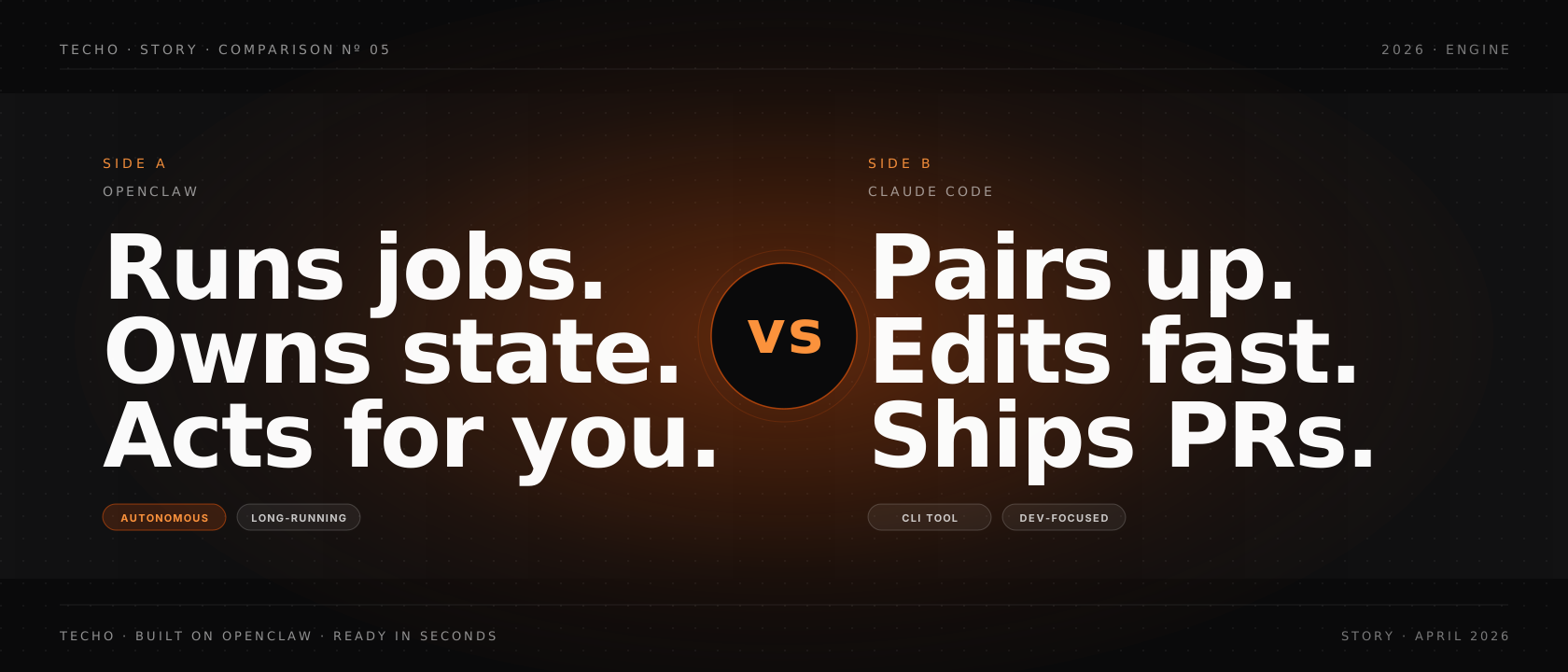
Both live on the same family of language models. The products solve different problems. OpenClaw is an agent runtime: a long-running process that plans, uses tools, keeps memory, and owns outcomes across days. Claude Code is a coding assistant: a CLI that pairs with a developer inside a repository, moves fast through edits, tests, and commits, then stops when you close the terminal. If you know which shape you need, the rest of this page is the details.
We build Techo — a ready-to-use AI concierge hosted on OpenClaw — so we are biased, but the comparison is not. Claude Code does a job OpenClaw was never meant to do, and the reverse is also true. This piece is the honest version of that split, with the architecture, the cost model, and the decision rule that keeps teams from buying the wrong tool.
§The one-line answer
Everything that follows is the long version of that sentence, with the architecture and the costs that decide which way you should tilt for a given project.
01Two different shapes of AI
OpenClaw is an open-source engine for autonomous agents. Its shape is a loop: receive a goal, plan, call tools, read the result, update memory, decide the next step, repeat until the goal is met or handed off. It runs on a server or a schedule, talks to the outside world through plug-ins, keeps state in a memory store, and is designed to act on behalf of a user who is not at the keyboard.
Claude Code is a developer-facing CLI from Anthropic. Its shape is a conversation tied to a workspace: a developer types a request, Claude reads files, proposes edits, runs tests, asks for confirmation, and moves the repository forward. It is optimised for the round-trip between a human and a codebase. When the human closes the terminal, the session ends.
OpenClaw is
A runtime. Long-running, stateful, tool-calling, schedulable. Built to be the autopilot behind a product, not a developer-facing tool.
Claude Code is
A coding companion. Short-lived, in-repo, dev-driven. Built to help one engineer ship code faster inside a codebase they already know.
Framed this way, “which is better” becomes the wrong question. “Which shape does the job actually want?” is the right one.
02The jobs each was built for
OpenClaw shines when the work outlives the operator. A concierge booking restaurants while you sleep. A research agent crawling regulatory filings overnight. A personal-ops agent cancelling a subscription tomorrow morning because a renewal alert fired. A customer agent holding a conversation across three days and four channels. The common thread is duration and autonomy: the job takes longer than a human attention span, and the human does not want to babysit it.
Claude Code shines when a developer wants a second brain inside a repository. Refactoring a module. Writing a migration. Reading an unfamiliar codebase to answer a question. Running tests, reading the failure, patching, re-running. Debugging a flaky integration. The common thread is interactivity and locality: the work is bounded by the edit-test-commit cycle, and the human makes the calls.
Neither tool is bad at the other’s job — they are simply not the shape. Running an always-on concierge inside a CLI is possible but awkward. Asking an autonomous agent to “pair with me on this diff for twenty minutes” is overkill. Pick the shape first, then the model.
03Architecture, side by side
The engine choice tells you everything. OpenClaw architecture assumes process, state, tools, and humans-in-the-loop. A running OpenClaw agent has a planner, a memory store, a tool registry, a scheduler, a sandbox for tool execution, and hooks to pause for human approval on irreversible actions. It persists between sessions by default. It is built for MCP, plug-ins, and long-running jobs with observability.
Claude Code architecture assumes a developer and a repository. The CLI has file access, shell access, a test runner bridge, a diff system for reviewable edits, and a conversation that stays in one workspace. Memory is scoped to the session, with lightweight persistence through project files and a simple allow-list of commands. It is built for speed-of-iteration, not autonomy.
04Memory and state
This is the single biggest axis that separates an agent runtime from a coding companion, and it is the one most comparisons skip.
OpenClaw is stateful by design. A structured memory store persists user preferences, task history, active plans, and the contextual breadcrumbs an agent uses to stay coherent across sessions. The agent that booked your flight yesterday can reference that booking tomorrow without rereading the whole inbox. The memory is structured, editable, and auditable — not a chat transcript.
Claude Code keeps session state, not long-term memory. Within a session, it remembers the conversation and the working set of files. Across sessions, it relies on the repository and project configuration to rehydrate context. That is the right trade-off for coding: the codebase is the state, and you do not want a CLI quietly forming opinions from last Tuesday.
The implication: if your product needs to remember a user, an account, a portfolio, or a multi-day plan, you want OpenClaw. If your product needs to remember a branch, you already have Git.
05Cost model — what you actually pay for
The pricing shapes match the product shapes. Rough 2026 numbers:
Claude Code is sold as a developer subscription with model usage bundled, plus pay-as-you-go for heavier accounts. For a single engineer using it for 20–40 hours a week of coding, the monthly cost sits in the tens to low hundreds of pounds. Predictable. Generous for interactive work.
OpenClaw itself is open-source — zero licence fee. Your running costs are the model tokens each agent consumes, the memory and tool infrastructure, and the host you deploy it on. A lightly-used internal agent can cost a few pounds a month. A customer-facing concierge running thousands of tool calls a day is a different ledger.
Hosted OpenClaw — the category Techo sits in — bundles the host, memory, scheduler, guardrails, and integrations into a fixed per-user price. For teams that do not want to run infrastructure to run agents, this is usually the cheapest total cost by the time you include the non-obvious pieces.
06When to pick each
Short rules. Pick OpenClaw when at least two of the following fit the job:
- The agent must keep running after the operator closes the laptop.
- The task has persistent memory of a user, a customer, or a multi-day plan.
- The work is scheduled: cron, triggers, webhooks, queues.
- The product is customer-facing, not developer-facing.
- You need a human-in-the-loop gate on irreversible actions.
- You want a plug-in ecosystem — MCP, tools, skills — rather than one-off scripts.
Pick Claude Code when at least two of the following fit:
- The work is inside a repository, with a developer driving.
- You want fast, reviewable diffs rather than autonomous actions.
- The task ends when the terminal closes.
- You need to explore an unfamiliar codebase quickly.
- You want to run tests, scripts, and commands in a trusted dev environment.
- Your deliverable is a pull request, not a long-lived service.
If a job matches both lists equally, you are probably describing the build-and-run pattern from the next section.
07Using them together — the real 2026 pattern
Most teams that ship agents well use both, wired together. Claude Code builds the agent; OpenClaw runs it.
Inside a repository, Claude Code reads the OpenClaw codebase, edits tool definitions, writes skills, tightens prompts, generates tests, and opens pull requests. It is the pair programmer that keeps the agent’s software healthy. Once the change merges, OpenClaw picks up the new version and keeps running — with its memory, schedules, and users intact.
Claude Code is the developer on the agent. OpenClaw is the agent on the customer.
Concretely, a healthy setup in 2026 looks like this:
- Authoring loop — Claude Code runs locally in the OpenClaw repo. The developer asks it to add a new tool, refactor a skill, or fix a regression. Edits are reviewed as diffs. Tests run in-CLI.
- Runtime loop — OpenClaw runs in production. Agents receive events, call tools, keep memory, pause for human approvals, and log observability traces. The operator is not in the loop most of the time.
- Handoff — When OpenClaw surfaces a regression, the operator copies the trace into Claude Code and fixes the codebase. The fix deploys. The runtime inherits it without forgetting its users.
- Shared substrate — Both use the same tool definitions, the same model family, the same logging. The boundary is “who drives”, not “which AI”.
☰Cheatsheet: OpenClaw vs Claude Code in 2026
One table to keep the decision straight:
| Axis | OpenClaw | Claude Code |
|---|---|---|
| Primary shape | Autonomous agent runtime | Developer CLI / pair coder |
| Who drives | The agent | A developer |
| Session length | Minutes to weeks | Minutes to hours |
| Memory model | Structured, persistent | Session + repository |
| Tool ecosystem | Plug-ins, MCP, skills | Shell + files + tests |
| Scheduling | Cron, triggers, webhooks | Interactive only |
| Human-in-the-loop | First-class | Implicit (you are it) |
| Deployment | Server, container, managed | Local dev machine |
| Observability | Traces, logs, replays | Terminal output |
| Cost shape | Tokens + host | Flat dev subscription |
| Best-fit job | Customer-facing autopilot | Shipping code |
?FAQ
Is OpenClaw the same thing as Claude Code?
No. OpenClaw is an open-source agent runtime — a long-running process that plans steps, calls tools, keeps memory, and owns outcomes across many tasks. Claude Code is a command-line coding assistant that pairs with a developer inside a repository, focused on reading, editing, and shipping code. Different jobs, different shapes.
Can Claude Code replace an autonomous agent framework?
For short, developer-driven sessions inside a codebase, Claude Code is superb and you do not need an agent framework on top. For long-running, outcome-owning jobs that persist across days, remember a user, and run on a schedule — the right shape is an agent runtime like OpenClaw, not a CLI.
Does OpenClaw work alongside Claude Code?
Yes, and most serious teams pair them. Claude Code builds and edits the OpenClaw agent itself — tools, prompts, plug-ins, tests. OpenClaw then runs those agents in production, on schedules, with memory and guardrails. One writes the agent, the other is the agent.
What does OpenClaw cost compared to Claude Code?
Claude Code is priced as a developer tool — a subscription that gives you an interactive CLI with model usage bundled in. OpenClaw itself is open-source; your cost is the model tokens the agents consume plus the host it runs on. For a lone developer, Claude Code is often cheaper. For an always-on agent serving many users, a hosted OpenClaw model — like Techo — tends to beat ad-hoc CLI usage once you factor in memory, scheduling, and human-in-the-loop controls.
When should I pick OpenClaw?
Pick OpenClaw when the job is long-running, needs persistent memory between sessions, has to act on behalf of a user outside a terminal, runs on a schedule, must survive process restarts, or needs a structured plug-in system for tools. Any “autopilot” scenario — concierge, ops agent, research agent — belongs on an agent runtime.
When should I pick Claude Code?
Pick Claude Code when a developer is in the loop, working inside a repository, wants to move through edits, tests, and commits with an assistant that reads the codebase fast. It is the right tool for shipping software. It is the wrong tool for running an agent that talks to a customer while you sleep.
§Where Techo fits
If you have read this far, the decision is probably not “OpenClaw or Claude Code”. It is “we want an agent, and we want to ship the software behind it” — which is a two-tool answer.
Techo is ready-to-use OpenClaw — an AI concierge built on the engine, with memory, scheduling, integrations, human-in-the-loop, and hosting set up. If you want an agent that remembers your users and runs around the clock without a platform team to stand it up, Techo is the shortcut. Teams still write their agents’ logic the way they prefer — Claude Code is a popular choice for that authoring loop — while Techo owns the runtime.
The honest sentence to end on: Claude Code is how you build the agent; OpenClaw is how the agent lives. Choose both, in that order, and you will not optimise the wrong thing.