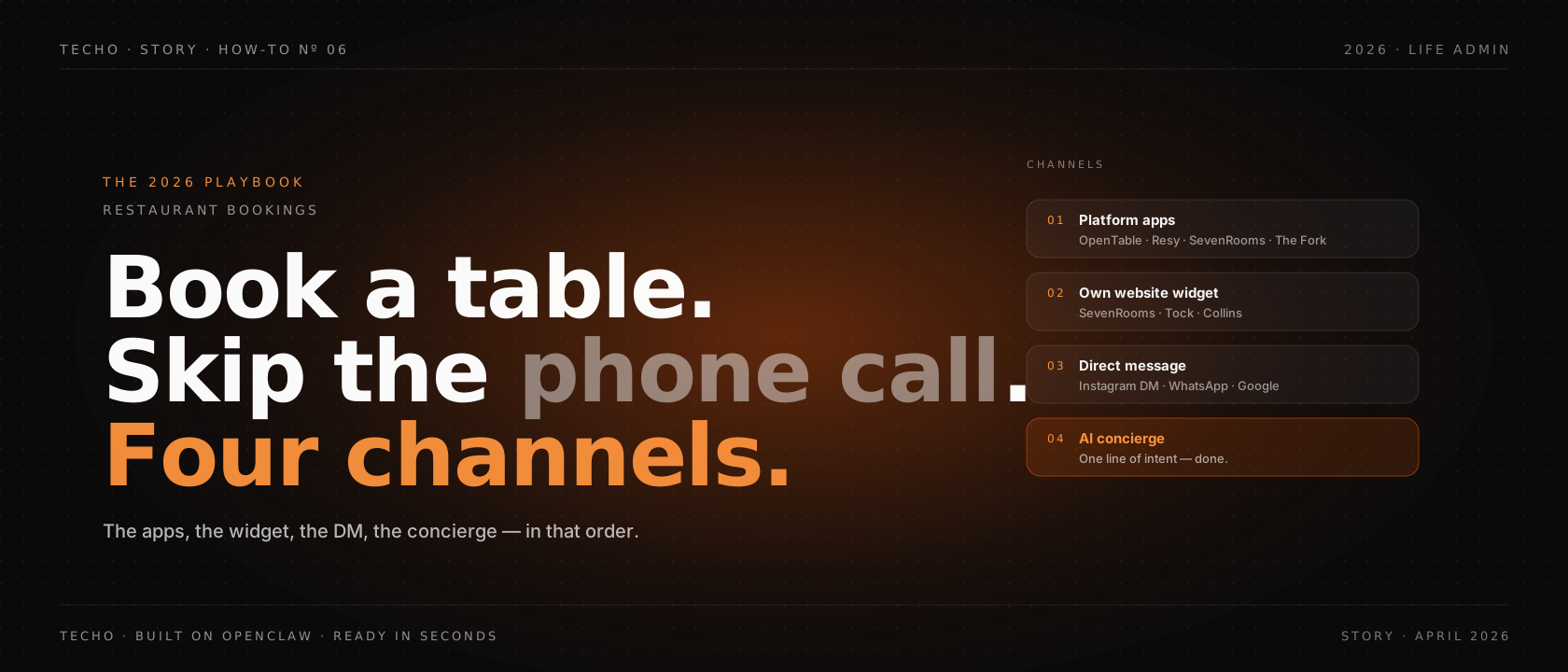
Booking a restaurant without picking up the phone is, in 2026, the normal case. Four channels now cover almost every venue worth eating at: platform apps like OpenTable and Resy, the restaurant’s own website widget, direct messaging on WhatsApp or Instagram, and a concierge that books on your behalf. Calls are reserved for the edge cases — last-minute walk-ups, very small venues, and private events large enough to need a deposit. This piece is the short playbook for the other 90 per cent.
We build Techo — a ready-to-use AI concierge that books restaurants among dozens of other life-admin jobs — so we watch this problem daily. The advice below is what a good concierge would do on your behalf, stripped of the automation so you can do it yourself in a spare five minutes.
§The one-line answer
Everything that follows is the long version of that sentence — the channels, the six-step flow, and the handful of edge cases where the quickest path really is to pick up the phone.
01Why booking a restaurant still feels analog
For roughly a decade, consumer expectations outran restaurant software. Banks, airlines, and even the DVLA built respectable booking flows while hospitality stayed on a patchwork of hand-written diaries, phone lines that rang into empty kitchens, and generic email addresses that no one read. Some of this was budget. Most of it was habit: a host who has run a dining room on a paper ledger for fifteen years is not going to adopt new software the week your table goes cold.
The turn happened quietly. OpenTable and Resy ate London and the major UK cities first, SevenRooms took the high end and hotel groups, The Fork filled in mainland Europe, and pub groups settled on DesignMyNight. At the same time, small venues learned that Instagram DMs and WhatsApp convert better than any contact form. By 2026, the story is finally flipped: the phone is the fallback, not the default.
Why does it still feel stuck? Because the long tail is long, and any one person’s favourite little wine bar might be the one that never joined a platform. The playbook below assumes you will sometimes lose twenty seconds to that reality, then route around it.
02Four channels that replace the phone call
Think of restaurant bookings as a four-channel problem in 2026. In order of how often they work:
1. Platform apps
OpenTable, Resy, SevenRooms, The Fork, DesignMyNight. Best for mid-market through upper-mid in the UK, EU, and US. Reliable, fast, real-time availability. Weakness: coverage dips for very small, very new, or very old-school venues.
2. Restaurant’s own widget
Many venues embed a “Book a table” widget on their website (often a white-labelled version of SevenRooms, Tock, or Collins). For anything with a Michelin bib upwards, this is often the preferred path.
3. Direct message
Instagram DM, WhatsApp Business, Google Business chat. Small venues, neighbourhood bistros, supper clubs. Surprisingly fast — most independents read their Instagram inbox before they read email.
4. AI concierge
You send one line of intent (“Tuesday, seven-thirty, two, somewhere quiet in Fitzrovia”). The concierge searches, ranks, books, and calendars it. The four channels above become an implementation detail.
The decision tree is almost always: try channel 1, fall back to 2, fall back to 3, and only reach for the phone if none of those surface an option.
03The six-step playbook
A compact routine that turns a vague idea for dinner into a confirmed booking in under five minutes.
- Define the constraints. Date, window, headcount, neighbourhood or a tube-stop radius, budget band, and one or two vibe words (quiet, lively, romantic, kid-friendly). Everything downstream is faster if these are written down, even as a note to yourself.
- Search the platforms. Start with OpenTable or Resy. Filter by neighbourhood, party size, and time window. Star-rating is noisier than editorial lists — shortlist two or three options, not ten.
- Cross-check the venue’s own page. Sometimes the platform shows “no availability” while the restaurant’s own widget shows a table. This is a common gotcha; always double-check the site before giving up.
- If no widget, DM them. Instagram first, WhatsApp second. Include date, time, headcount, any dietary notes, and the occasion in a single message. A one-shot message gets a faster answer than a back-and-forth.
- Book and capture the confirmation. Screenshot the confirmation or forward the email to your calendar. Add the address, the booking reference, and the cancellation policy as notes on the event.
- Set a gentle reminder. Two hours before the booking is usually the right window to check transport, top up your water bottle, or ring ahead if something has changed. Most cancellations happen after the free window exactly because this reminder is missing.
04Diets, special occasions, and bigger tables
The default booking flow handles couples and fours. It creaks a little when allergies, anniversaries, or groups enter the picture.
Dietary requirements. Every major platform now has a “special requests” box. Use it, and keep the note short and specific: “one coeliac, one dairy-free, no nuts” is more useful than “allergies — please advise”. Restaurants appreciate precision, and the kitchen actually sees these notes printed on the booking ticket. For severe allergies, a follow-up DM the day before is polite, not excessive.
Special occasions. Anniversaries, birthdays, and proposals are worth flagging. Most venues have a quiet “occasion” workflow — a dessert written on with a message, the best table in a room, a little more patience with a nervous guest. Asking nicely in the requests box is usually enough.
Bigger tables. From about seven guests up, the booking behaviour changes. Widgets start pushing you to a group-enquiry form, a set menu, or a deposit. This is a feature, not a barrier. A form response captures the detail a phone call would lose, and the paper trail protects both sides on the night. Expect twenty-four to forty-eight hours for a human reply, and start the process a week or two out if the venue is popular.
05When a phone call is actually unavoidable
There is still a small surface where a voice call is the fastest route to a confirmed table. Recognising it early saves frustration.
- Very small venues. Ten-to-twenty-cover places often do not use any system. Their Instagram is quiet. A short call is frequently the only path.
- Same-day, same-hour bookings. Most platforms cut off online booking ninety minutes before the slot. If you are trying to eat in an hour, calling directly is usually quicker than tapping through four apps.
- Complex private events. Set menus, drinks packages, deposits, AV requirements — a voice conversation collapses an email chain into five minutes.
- Negotiating the unusual. A dog, a pram, a bottle you want to bring, a dietary need the form cannot capture. All of this lands more cleanly with a human.
None of this is a large share of the bookings you will make in a year, but it is where the remaining value of a phone call quietly lives.
06Cancellations, no-shows, and graceful exits
Restaurants care more about no-shows than about cancellations. A cancellation frees a table in the system their host is watching. A no-show costs them a cover.
Every platform lets you cancel or modify a booking in two taps, and almost every venue has a free cancellation window — usually twenty-four or forty-eight hours. Inside that window you may forfeit a deposit, but you will never be charged more than the policy. Outside the window, there is no cost at all.
The one rule that matters: if you cannot make it, tell them. A one-line message on the platform or via DM is always preferred to silence. It protects your account, keeps your standing at venues you return to, and — when volume is tight — helps a waiting guest get the table.
☰Cheatsheet: which channel for which booking
One table to keep the decision straight in the moment:
| Scenario | First try | Fall back to |
|---|---|---|
| Tuesday dinner for two | OpenTable / Resy | Restaurant’s own widget |
| Sunday lunch for four | OpenTable / Resy | Instagram DM |
| Small independent bistro | Instagram DM / WhatsApp | Phone call |
| Upper-mid or hotel restaurant | Restaurant’s own widget | SevenRooms / Resy |
| Group of eight-plus | Group enquiry form | Email to the events address |
| Proposal or anniversary | Widget + occasion note | DM the day before |
| Anywhere, in the next hour | Phone call | Walk in |
| Michelin, two months out | Own website at release time | Waiting list |
| Abroad, unfamiliar city | The Fork / hotel concierge | AI concierge |
| You just want dinner, somewhere good | AI concierge | Editorial list + widget |
?FAQ
Can I really book any restaurant without calling in 2026?
Most of them, yes. The big booking platforms cover the vast majority of restaurants that take reservations, and a surprising number accept bookings via Instagram DM, WhatsApp, or a chat widget on their own site. The edge cases — tiny family-run kitchens, late-notice walk-ups, large private events — are the ones that still reward a voice call. Everything else is a few taps.
Which apps are the most reliable for booking in the UK?
OpenTable and Resy cover most mid-market and upper-mid restaurants in London and the major UK cities. SevenRooms shows up for higher-end and hotel restaurants. The Fork is broader in Europe. For pubs and casual venues, DesignMyNight and the venue’s own website are often the best path. None of them covers everything, so a quick check across two or three platforms is normal.
What if the restaurant does not list any online booking option?
Check their Instagram and Google Business profile first — many small venues funnel bookings through DM or a simple Google booking button even when their website is quiet. If there is a WhatsApp number, that almost always works. If none of those are present and the venue is small, a voice call is usually the right move — a short, polite call is often answered faster than an email to a generic inbox.
How do I book a table for a large group without calling?
For groups up to six, the standard booking widgets are usually fine. From seven upwards, most restaurants treat it as a “group enquiry” with a form — you submit date, time, headcount, dietary notes, and expected budget, and the venue replies by email within a day or two. The form path is slower but produces a paper trail for deposits, pre-orders, and private hire, which a call cannot easily match.
Is it rude to cancel or modify a booking online?
No. Restaurants prefer a clean digital cancellation to a no-show by a wide margin, because it frees the table in the system their host is actually watching. What is poor form is cancelling within the window their policy specifies, or failing to cancel at all. If you are cancelling late, a short message — on the platform, by email, or via DM — is genuinely appreciated.
Can an AI concierge book a restaurant on my behalf?
Yes, and this is the cleanest path for people who book often. A good AI concierge remembers your allergies, your favourite cuisines, your usual headcount, and the neighbourhoods you like. You give it a date and a vibe; it searches, picks two or three options, books, and adds the confirmation to your calendar. The phone call is replaced by a one-line request.
§Where Techo fits
If you only book the occasional dinner, the playbook above is plenty. If you book often, travel, or plan dinners for groups with specific needs, the calendar maths stops working. That is the seam an AI concierge fills.
Techo is ready-to-use OpenClaw tuned for life admin: it remembers your allergies, your partner’s allergies, the neighbourhoods you like, and the venues you return to. You send one line of intent — “Friday, eight, quiet, walking distance” — and it returns two or three booked options with calendar holds and cancellation notes.
The phone call was never the problem. The friction was the mental switching cost — from your life to the restaurant’s operations and back.
None of this removes the occasional joy of calling a tiny neighbourhood place. It just stops making that call the default.