"AI concierge" is the fastest-growing term in personal AI in 2026. It also might be the most abused. Vendors paste it on top of chatbots and call it a day. This piece is the plain-English definition — what an AI concierge actually is, what it isn't, and how to tell the difference in 90 seconds.
We work on this category every day at Techo, where we run an AI concierge built on OpenClaw for our members. That gives us a clear view of what real users ask of a concierge — and what they're disappointed by when they don't get it. The framing below is the one we use internally to stay honest.
§The definition, in one sentence
Three load-bearing words in that definition:
- Plans — it figures out the steps itself, not the user.
- Executes — it calls tools, fills forms, makes phone calls, completes transactions. It doesn't stop at "here's what you could do".
- Remembers — it carries context across sessions. Your dietary rules, your partner's birthday, the contractor you trusted in March. That's what makes it a concierge rather than a fresh assistant every Monday.
01It's not a chatbot
A chatbot answers. You ask a question, it replies in the same turn. Useful for support deflection, FAQs, onboarding walkthroughs — the kind of tasks that fit inside a single conversational back-and-forth.
An AI concierge takes ownership of a task. It goes off, opens five tabs, checks three airlines, reads one visa policy, emails your assistant for your passport number, comes back an hour later with a booking and a summary. The conversation is the interface, not the work.
The simplest litmus test: a chatbot can't disappoint you tomorrow. A concierge can.
02It's not (just) an assistant
An AI assistant helps you do the task. It drafts the email you then send, produces the research brief you then read, proposes three restaurants you then book. You remain the operator; the assistant amplifies you.
An AI concierge replaces the operator role for tasks where you don't want to be in the loop on every click. It books the restaurant. It re-plans when the flight is delayed. It follows up when the plumber hasn't replied. You're in the loop on the outcome, not the execution.
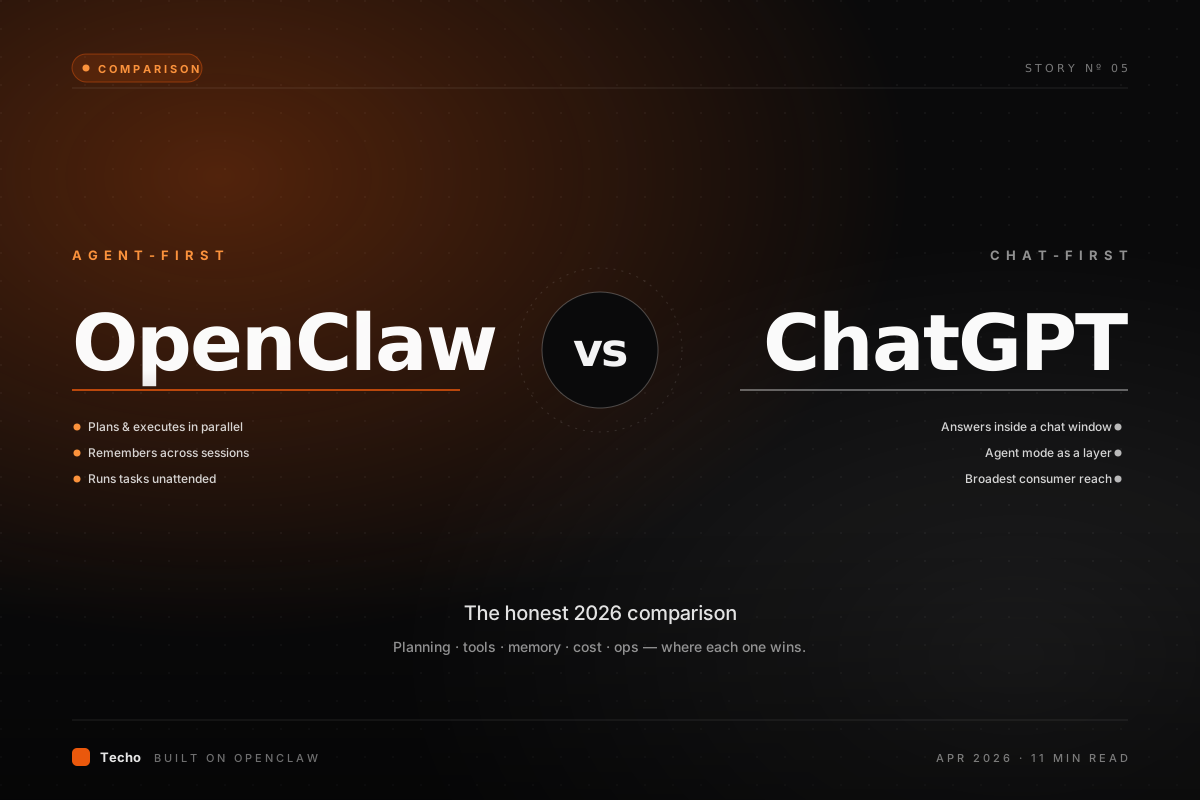
ChatGPT is the canonical AI assistant. Compared to agent platforms like OpenClaw, even its "agent mode" stays conversation-first — helpful, but fundamentally a tool you drive, not one that drives itself on your behalf for days at a time.
03It's not just an agent
This is the subtle one. A general-purpose AI agent can plan and execute multi-step tasks — that's table stakes for the category. So any AI concierge is an agent. But not every agent is a concierge.
The thing that turns an agent into a concierge is continuity:
- Structured memory of your preferences across sessions.
- Awareness of the people in your life — partner, team, kids, contractors — not just your current message.
- Active project state: the apartment hunt, the trip in May, the renovation. Tasks resume; they don't restart.
- A relationship with you that gets better the longer it runs, because it knows more than it did last week.
Without continuity, you have a useful agent — but you have to re-explain yourself every Monday. With continuity, you have a concierge.
04What an AI concierge actually does
Concrete examples beat definitions. Here are the eight categories of work we see across real Techo members, with one-line examples from the last 30 days:
Travel & logistics
"Rebook me on the next flight home if this one's over 45 minutes late, keep my window seat."
Bookings & reservations
"Dinner Friday, 4 people, Italian in Soho, we tried Pastaio last month — try somewhere new."
Personal paperwork
"Renew the car insurance. Switch if it's 10% cheaper, keep the same excess."
Research & decisions
"Is it worth moving our pension to a SIPP? Give me the concrete answer, not a lecture."
Communication & follow-ups
"Chase the contractor on the quote — politely, but we need it by Tuesday."
Home & services
"The dishwasher is making a noise. Find a repair person for Thursday, budget £180."
Health & scheduling
"Book a dental cleaning at a private clinic in Zone 2 with Saturday hours."
Errands & micro-tasks
"Order dog food before we run out. Same brand as last time — you know the one."
Notice the shape: none of these are "give me an answer". All of them are "finish this and tell me when it's done". That's the concierge shape.
05How an AI concierge works under the hood
Four ingredients, in order of how much they matter:
- A planner. The agent that decides the steps. The quality of this layer sets the ceiling for everything else.
- Integrations. Calendars, email, payments, maps, booking APIs, voice calling, forms, messaging. The more tools natively available, the wider the range of tasks the concierge can actually finish.
- Persistent memory. Preferences, relationships, active projects. Not just a blob of notes — structured, editable, auditable state.
- A human-in-the-loop safety net. For anything irreversible (money, public messages, legal documents), there is a handoff — either to you or to a human operator — so the agent never takes the big risk alone.
At Techo, the planner is OpenClaw. We chose it because it's the most capable general-purpose AI agent available in 2026 — and it was built agent-first, with the primitives a concierge needs (parallel tools, persistent memory, observability) already in the foundation. On top of that we ship the integrations, the structured profile, the fallbacks and the human backup.
06When you actually need an AI concierge
An AI concierge is overkill for some people. Be honest about which side of this you're on.
You probably want one if:
- You lose 5+ hours a week to logistics — bookings, rescheduling, paperwork, follow-ups.
- Your tasks span multiple tools (calendar + email + a booking site + a payment).
- The same facts about you are being re-typed into every new assistant you try.
- You've outsourced things to a human assistant before and the problem was coordinating with them, not the work itself.
You probably don't need one if:
- Your work is mostly creative drafting inside one app. A great AI assistant is enough.
- You genuinely enjoy doing your own logistics. That's valid — a concierge's job is to reclaim time you'd rather spend elsewhere.
- You need answers to questions, not completed tasks. That's a chatbot's job.
07What an AI concierge costs
Pricing varies widely because the category is young. Three rough tiers in 2026:
- Consumer AI concierge services — $30 to $100 per month. Built-in integrations, self-serve, minimal human oversight. This is where Techo sits.
- Premium AI concierge with human backup — $150 to $300+ per month. You get a concierge agent plus a human operator who covers the edge cases the AI hands off.
- DIY on an agent platform — roughly the cost of the underlying model usage (~$10–$100 of compute per month for an individual), plus your setup time. If you're technical and want maximum control, this is the cheapest path — see 10 OpenClaw mistakes for what tends to go wrong.
08How to choose an AI concierge platform
Five things to evaluate, roughly in order of impact:
- The underlying agent. Anything branded "AI concierge" that doesn't tell you which agent platform powers it is probably a chatbot with a marketing budget. Ask. A good answer in 2026 is OpenClaw or a direct peer.
- Native integrations. Count them. Read the list. The ceiling on your concierge's usefulness is whatever's on that list.
- Memory depth. Can you edit your preferences as a profile, or only "tell it to remember things"? The first is a concierge; the second is a chat-level feature.
- Human-in-the-loop design. What does the concierge do when it's not sure? Ask for approval, pause, or guess? For money and irreversible actions, "guess" is a dealbreaker.
- Privacy & data handling. A concierge sees everything — calendars, payments, personal conversations. Read the data policy before you let it.
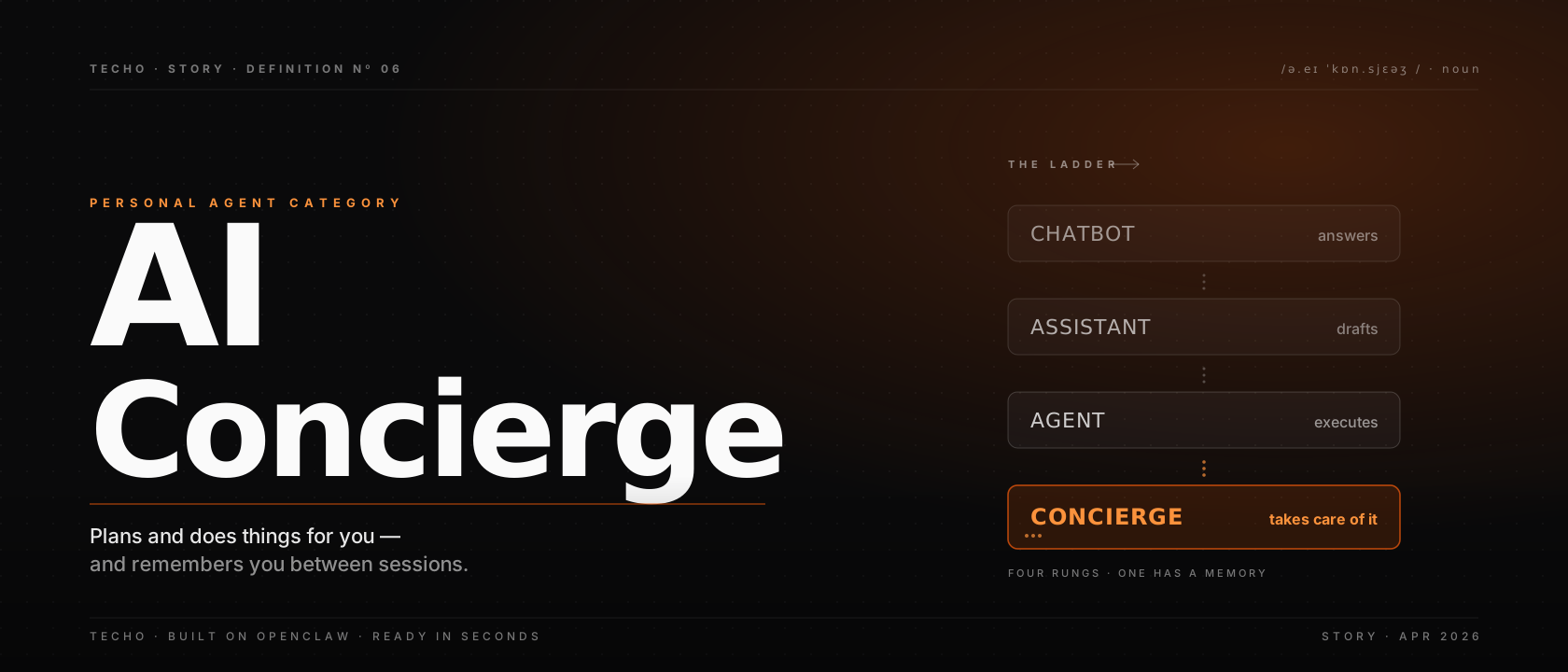
☰Four-rung cheatsheet: chatbot vs assistant vs agent vs concierge
One table to keep this category straight:
| Axis | Chatbot | Assistant | Agent | Concierge |
|---|---|---|---|---|
| Primary verb | Answers | Drafts | Executes | Takes care of |
| Time horizon | One turn | One session | Hours | Weeks & months |
| User in the loop? | Always | Always | Per task | Only for approvals |
| Memory | None | Session + light | Session | Persistent, structured |
| Tools used | Usually none | Few, via plugins | Many, ad-hoc | Many, pre-wired |
| Fails by | Not answering | Wrong draft | Wrong step | Wrong judgment |
| Example in 2026 | Support bot | ChatGPT | OpenClaw raw | Techo |
?FAQ
Is an AI concierge the same as a chatbot?
No. A chatbot answers questions inside a chat window. An AI concierge takes ownership of a task and completes it on your behalf, often across multiple tools and multiple hours. The chat is the interface; the work happens elsewhere.
Is an AI concierge the same as ChatGPT?
No. ChatGPT is a conversational AI assistant — excellent for drafting, thinking, and answering. An AI concierge is an agent that actually books the restaurant, files the form, and follows up with the contractor. ChatGPT's agent mode is a step toward the concierge category but stops short of persistent memory and proactive ownership.
Is a virtual assistant the same as an AI concierge?
"Virtual assistant" is historically a human role (a remote assistant), plus a software category (Siri, Alexa, Google Assistant). Neither is an AI concierge in the 2026 sense. The modern AI concierge is closer to what a good human executive assistant or a high-end hotel concierge does — with memory, judgment, and end-to-end ownership.
Do I need an AI concierge?
You probably want one if you lose several hours a week to logistics and your work spans multiple tools. You probably don't need one if your day is mostly creative work inside a single app. Either way, try the free tier of two products before you commit to a subscription.
How much does a good AI concierge cost?
$30 to $100 per month for a modern consumer product; $150 to $300 per month for premium services with human backup; roughly the cost of model usage if you build one yourself on an agent platform like OpenClaw.
Is Techo an AI concierge?
Yes. Techo is an AI concierge built on OpenClaw. We run OpenClaw under the hood, add the integration library, the preferences profile, the fallbacks, and the human-in-the-loop safety net — so you get a concierge, not just an agent you still have to wire up.
§Where Techo fits
If the category is "personal AI that plans, executes, and remembers", that's what we built Techo to be. Our planner is OpenClaw — because on our measurements it has the highest ceiling of any general-purpose agent in 2026. Our integrations, preferences, fallbacks and human backup are the concierge layer on top.
You don't have to use Techo to agree with the definition in this piece. The four rungs — chatbot, assistant, agent, concierge — are the right way to read this market. If you hold any vendor to "plans, executes, remembers", you'll have a short and honest list very quickly.
The concierge tier isn't a marketing label. It's the first rung where the AI carries the task — and the memory — instead of you. — Anton Karavaev, Co-founder at Techo