OpenClaw is the engine. Techo is the hosting around it. If you have already evaluated agent frameworks and decided OpenClaw is the right one, the next question is whether you run it yourself or pay someone to run it for you. This piece is the line-by-line answer: what hosted OpenClaw replaces, what it leaves you in control of, and the small set of cases where self-hosting is still the better call.
The short version: hosted OpenClaw collapses about six to ten weeks of platform work into a sign-up flow. The long version — what those weeks are, what they cost, and where the seams are — is below.
§The one-line answer
Everything that follows is the line-by-line version of that sentence — the eight things Techo runs so you do not have to, the costs both ways, and the honest cases where self-hosting still wins.
01What “OpenClaw hosting” actually means
OpenClaw, as an engine, ships as a runnable binary, a set of SDKs, and a small reference deployment. That is enough to write an agent on your laptop and call it a working prototype. It is not enough to put that agent in front of paying users.
Between the prototype and the production agent sits a stack of unglamorous infrastructure: a memory store that survives restarts, sandboxes that isolate tool calls from your machine, a model router that fails over when one provider has a bad afternoon, a credentials vault for the MCP registry, a queue for scheduled work, a tracing layer that lets you debug an agent run from yesterday, a quota system, an auth-aware UI. None of it is interesting on its own. All of it is necessary.
“OpenClaw hosting” is the name for someone running that stack for you on top of the engine. The engine is the same OpenClaw the open-source project ships. The hosting is the difference between “works on my laptop” and “works for two thousand users at three in the morning”. Techo is one example of hosted OpenClaw, focused on the AI-concierge use case; other hosted OpenClaw vendors will appear over the next year, and that is healthy.
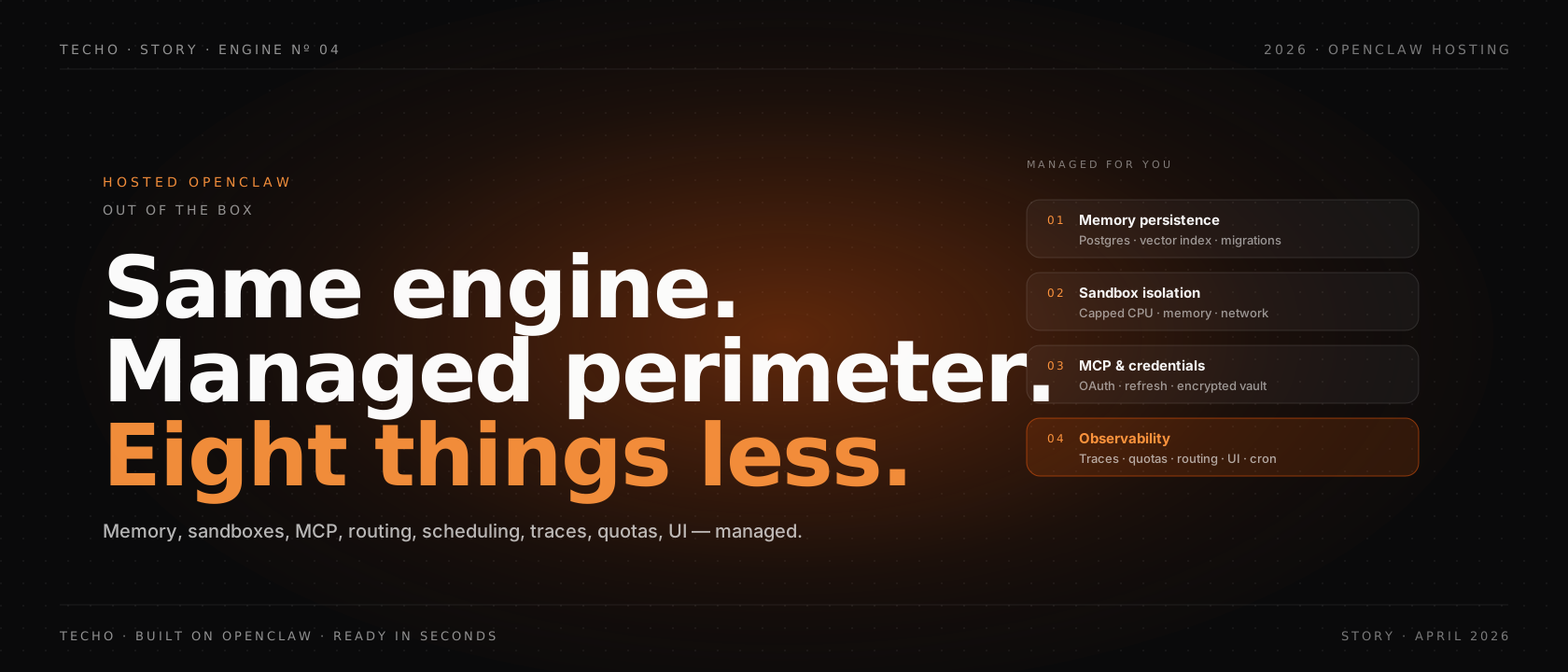
02Eight things Techo manages for you
The order below is roughly how often each one bites a self-hoster in their first ninety days.
1. Memory persistence
The store that holds what the agent has learnt about each user. Postgres + a vector index + a versioned schema migration. Techo runs it; you get an SDK call.
2. Sandbox isolation
Every tool call runs inside a short-lived sandbox with capped CPU, memory, and network. Self-hosting this on Kubernetes is a project; Techo ships it as a default.
3. MCP registry & credentials
OAuth flows, token refresh, scope negotiation, secret storage for every connector your users plug in. Encryption-at-rest is included; you do not buy a vault.
4. Model routing & fallbacks
One provider has a bad hour. Techo routes around it. Pricing, rate limits, and capability fingerprints are tracked centrally so a model swap is a config change, not a deploy.
5. Scheduled tasks
Cron for agents, with retry policy and dead-letter queues. Useful for daily digests, reminders, recurring concierge jobs.
6. Observability & traces
Every agent run is recorded as a step-by-step trace. Search by user, tool, error, or latency. Self-hosters end up rebuilding this badly.
7. Rate limits & quotas
Per-user, per-tool, per-tenant. Useful when one user’s runaway script tries to drain your model budget. Techo ships sensible defaults.
8. UI & auth
The control plane for non-developers: a dashboard, an inbox, an integrations panel, a settings UI. Auth, sessions, and password reset included.
None of these eight items is, on its own, a year of work. Together, they are the difference between a one-engineer prototype and a small, trustworthy SaaS. If you priced this stack as “an engineering sprint”, the honest estimate is six to ten weeks for a competent team and a longer tail of small fires for the year after.
03Self-host vs hosted, like-for-like
The trade-off is almost never “is the engine better hosted?” — it is the same engine. The trade-off is who you want owning the eight items above.
Self-hosting buys you control. Data stays in your VPC, your DPA is cleaner, your security review has fewer questions, and you can patch a sandbox the day it needs patching. The price is an on-call rota, a platform engineer for at least half their week, and the slow accumulation of glue code that future you will inherit.
Hosted buys you time. The first version of your product ships in days, not months. Your engineering hours go into the layer that differentiates you — the prompts, the user experience, the integrations — and not into running Postgres for someone else. The price is the operational lock-in we discuss further down: you stop being the team that decides when to upgrade the engine.
For most consumer apps, prosumer tools, internal tools at companies under a thousand seats, and almost any startup before product-market fit, hosted is the cheaper and faster option. For regulated workloads, a serious data-residency requirement, or a platform team that already exists and has spare capacity, self-hosting is the right call.
04Where the money goes
The first instinct is to compare the cloud bill. That is the wrong number. Two real costs dominate the model.
Engineering time. A platform engineer in the UK is roughly £90 000 to £130 000 fully loaded. The eight items in §02 come to about half their year for the first build and a quarter of their time forever after. That is £45k+ in year one, and a recurring £25k+ thereafter, before any cloud spend. Hosted OpenClaw sits comfortably under that line for the first thousand or two thousand active users.
Model spend. The model bill scales with usage in both worlds. Hosted vendors typically pass cost through with a margin; self-hosting buys you the option to negotiate directly with model providers, which becomes meaningful above roughly one hundred thousand pounds of annual model spend. Below that, the negotiation is not worth your finance team’s time.
05Exports, portability, and escape hatches
The fair question for any hosted product: how hard is it to leave?
OpenClaw, the engine, is open source. Techo runs OpenClaw, not a fork. That has two practical consequences. The memory format, the MCP registry, the tool schemas, and the run-trace shape are all the upstream OpenClaw shape, and the export endpoint returns them unchanged. You can stand up a self-hosted OpenClaw, point it at the export, and continue.
What is not portable is the operational layer. The dashboard, the on-call rota, the rate-limit policy, the model-router config — those are Techo’s, not OpenClaw’s. If you migrate to self-hosting or to another hosted OpenClaw, you rebuild that layer (or the new vendor brings their own version of it). The lock-in we accept is operational, not architectural — and that distinction is the one that matters for due diligence.
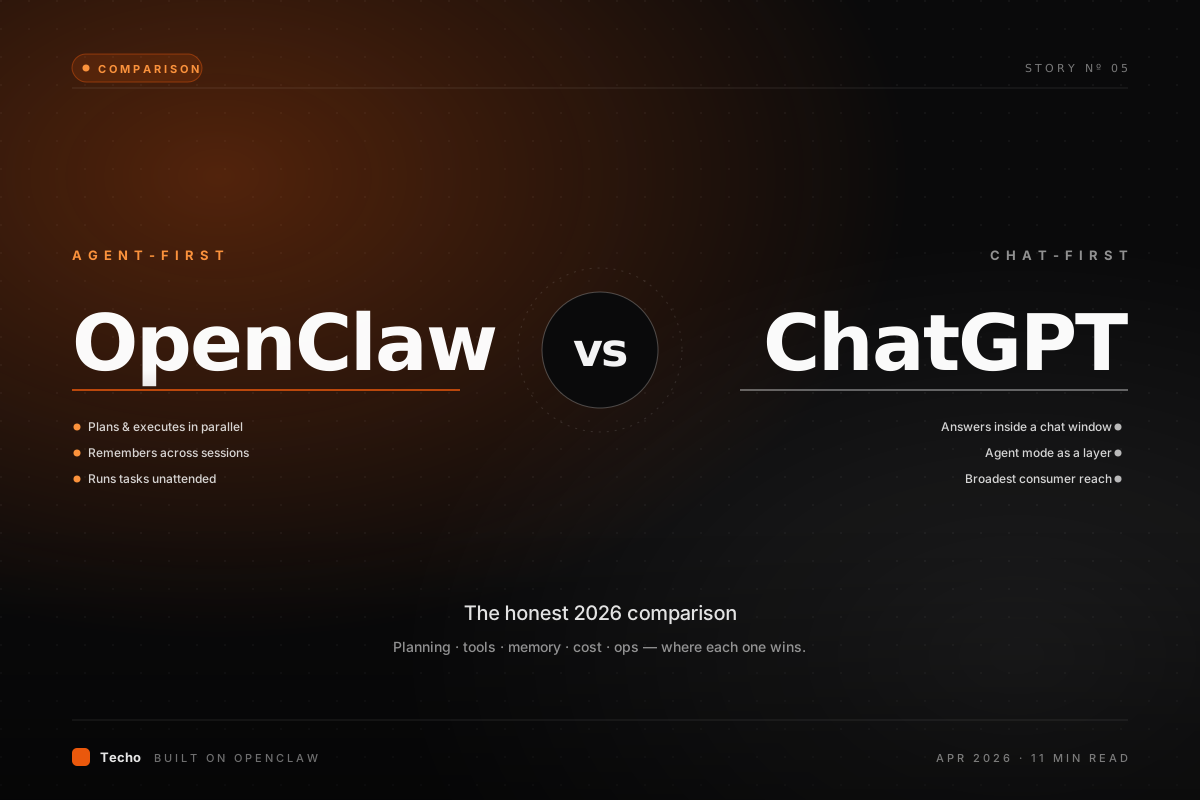
For a fuller picture of where OpenClaw fits in the wider agent ecosystem, our previous pieces compare it to Claude Code and ChatGPT’s agent mode; both are useful background reading before you commit one way or the other.
06Who hosted is for, who should self-host
A rough sorting that has held up across the customers we have onboarded so far.
Hosted OpenClaw fits well for:
- Solo founders and small teams who want an OpenClaw-powered product live this month.
- Consumer or prosumer apps where the differentiator is the experience, not the infrastructure.
- Internal tools at companies that do not have a dedicated platform team.
- Researchers and analysts running scheduled agent workloads who do not want to babysit Postgres.
- Non-technical operators who would not otherwise be able to use OpenClaw at all — the UI is the unlock.
Self-hosting is the better call when:
- You have a hard data-residency requirement (a regulated industry, an EU-only deployment, or a customer contract that names a region).
- Your security review needs the engine inside your VPC, with your auditors, on your patch cadence.
- You already have a platform team running stateful workloads, and adding OpenClaw is a minor delta on what they do.
- Your model spend is large enough that the economics of direct contracts beat hosted margins.
- You want to fork OpenClaw, or run an unreleased build, and need full control of the engine version.
☰Cheatsheet: hosted vs self-hosted, line by line
One table to keep the trade-off straight in the moment:
| Concern | Hosted (Techo) | Self-hosted |
|---|---|---|
| Engine | OpenClaw, managed | OpenClaw, run by you |
| Memory store | Managed Postgres + index | You operate |
| Sandboxes | Default, isolated | You build on K8s or similar |
| MCP registry | Built-in, OAuth handled | You wire each connector |
| Model routing | Multi-provider, fallback | You implement |
| Observability | Trace per run, searchable | You stand up the stack |
| Rate limits | Per-user defaults | You design the policy |
| Scheduled tasks | Cron + retries built-in | You run a queue |
| UI for non-devs | Included | You build it |
| On-call | Techo’s rota | Yours |
| Data residency | EU + UK; US optional | Wherever you deploy |
| First-year cost | Lower for < 2 000 users | Lower above ~ 200k model spend |
?FAQ
What is OpenClaw hosting?
OpenClaw hosting is the managed version of the OpenClaw agent engine. Instead of running your own servers, memory store, sandboxes, and MCP wiring, you sign in to a hosted control plane that already has those parts assembled and observable. Techo is one such hosted OpenClaw: the engine is OpenClaw, the operations layer around it is what Techo adds.
Do I need to self-host OpenClaw to use it in production?
No. Self-hosting is the right call when you have a strong data-residency requirement, a security review that needs the engine inside your VPC, or an existing platform team that wants the control. For most consumer apps, prosumer tools, and small teams, hosted OpenClaw is faster to ship and cheaper for the first year of operation.
How is Techo different from running OpenClaw myself?
Same engine, different perimeter. Self-hosting means you own the Postgres for memory, the sandbox runners, the MCP registry, the observability stack, the rate-limit broker, and the user-facing UI. Techo ships all of that as one product, with a sensible default for each, and a UI built for non-developers. You skip roughly 6–10 weeks of platform work.
Is hosted OpenClaw cheaper than self-hosting?
For the first year, almost always yes — because the cost of self-hosting is dominated by engineering time, not by the cloud bill. Once you cross roughly 200 active users on a heavy workload, the marginal economics of self-hosting can flip in your favour, but only if you already have a platform team. The honest answer is: model both, and include the cost of an on-call rota in the self-host column.
What does Techo manage that I would otherwise build?
Eight things, in order of how often they bite a self-hoster: memory persistence, sandbox isolation, MCP registry and credentials, model routing and fallbacks, scheduled tasks, observability and traces, rate-limit and quota policy, and a user-facing UI with auth. Most teams underestimate the last three until they ship.
Can I export my data and move off Techo?
Yes. Techo runs OpenClaw, not a fork, so the memory format, MCP registry, and tool schemas are portable by design. The export endpoint returns memory documents, MCP configs, and run traces in the OpenClaw native shape. You can boot a self-hosted OpenClaw, point it at the export, and continue. The lock-in we accept is operational, not architectural.
§Where Techo fits
Most teams evaluating OpenClaw are not really debating an engine — they are debating who runs the eight items in §02. If those items are work you want to do, self-hosting is honest and respectable. If they are work you would rather skip so your engineering time goes into the product itself, hosted OpenClaw is the shortcut.
Techo is ready-to-use OpenClaw with that operations layer already built: managed memory, sandboxed tool calls, an MCP registry with OAuth handled, multi-provider model routing, scheduled tasks, observability, quotas, and a UI usable by people who are not developers. The engine underneath is the same OpenClaw the open-source project ships, and the export path back to self-hosting is a documented endpoint.
The interesting question is not whether OpenClaw is the right engine. It usually is. The interesting question is who you want running it.
If hosted is the answer, that is what Techo offers. If self-hosting is the answer, OpenClaw is open source and the docs are good. Either is a reasonable choice; pretending otherwise is the only mistake.