The average inner-London diner now keeps OpenTable, Resy, SevenRooms, TheFork, Quandoo, two restaurant-direct apps, a WhatsApp thread for the friend group, and a Notes file of dietary quirks. An AI concierge for restaurant booking is the layer that makes that whole stack disappear. Not a chatbot that suggests “maybe try Dishoom Kingly”; an agent that holds your taste, watches your diary, and lands the table without you opening any of the apps.
§Verdict
The reason this is interesting in 2026, and not in 2023, is that agent runtimes are finally good enough to keep state across months of dining context without forgetting you stopped eating shellfish in March.
01What “on autopilot” really means
Autopilot is a loaded word, so it is worth being precise. A dining concierge does not silently book restaurants in your name and surprise you on Friday night. It runs a clearly bounded loop: gather a goal, draft an option set, confirm spend with a single tap, then act and monitor.
The shift is from twenty minutes per booking to roughly two. Not because the flow inside any one app got faster — it has not — but because the agent collapses the around-the-booking work the apps never owned: cross-platform search, dietary filtering, calendar deconfliction, dress-code checking, post-meal notes. The how-to companion piece on how to book a restaurant without calling walks through the four channels you would otherwise juggle by hand.
02The taste profile it builds
The piece that makes a concierge feel like a concierge, rather than a faster app launcher, is persistent memory. The first dinner is the longest conversation; from the second onward, it stops asking and starts inferring.
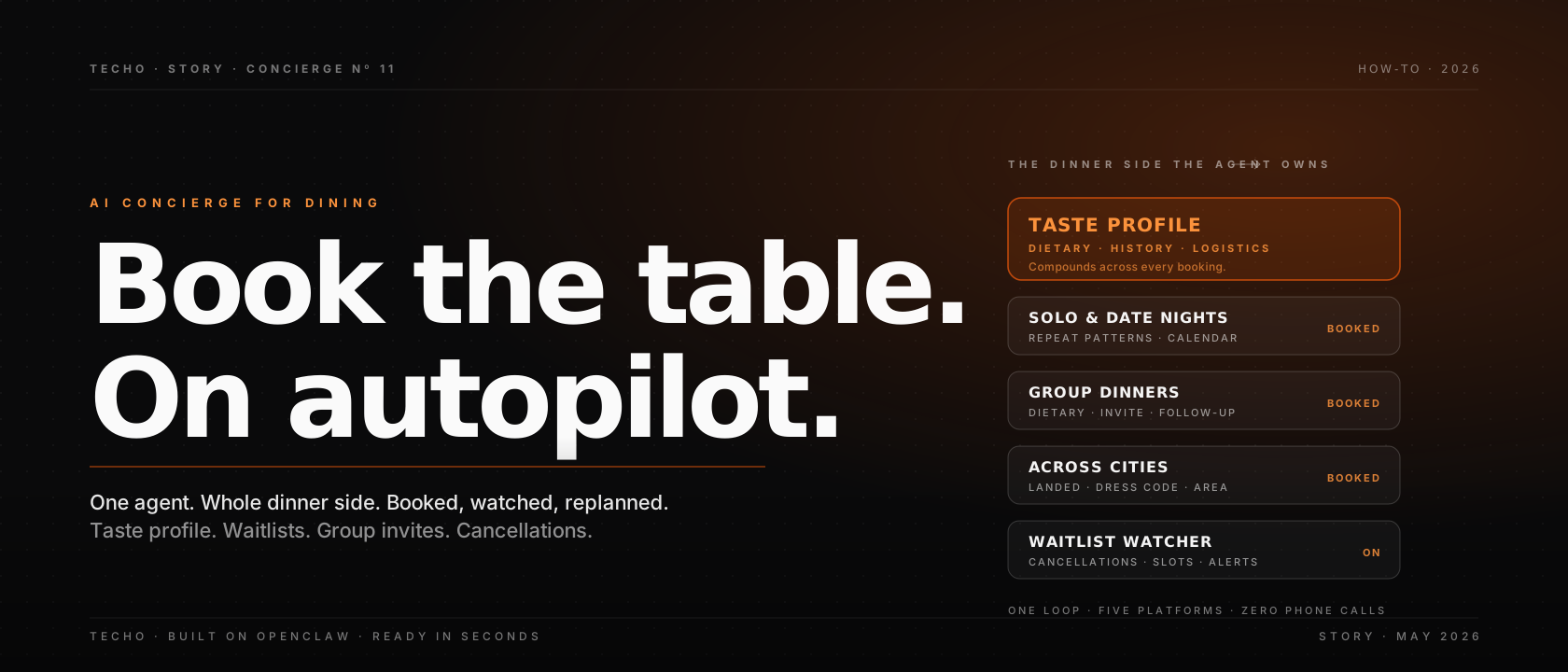
A useful dining profile lives in roughly four buckets. The unusual part is that it is in one place, attached to the agent that books on your behalf, instead of scattered across seven app caches.
1. Identity & cards
The card that takes the no-show fee, your loyalty IDs, who you typically dine with, the booking name you actually want printed on the cover.
2. Taste & dietary
Cuisines you reach for, cuisines you avoid, allergies, religious or ethical constraints, alcohol preferences, the specific restaurant you walked out of in 2024.
3. Logistics
Neighbourhoods you live in this season, working hours, default party size, latest dinner you can plausibly do midweek, dress-code tolerance.
4. History
Where you went, what you ordered, what you said about it after. This is the bucket that actually compounds over time.
From the second booking onward, almost none of this is asked again. The concierge already knows you do not want a five-course tasting on a Tuesday and will not eat at one specific Soho chain since the manager incident. That is the difference between a concierge and a chat skin on a search engine: continuity that compounds.
03The booking loop, slowed down
Underneath the conversation, the agent runs the same loop every credible 2026 concierge runs. For dining specifically, the four steps look like this.
Plan. The concierge takes “dinner with Priya, Thursday, modern Indian in Fitzrovia, mid-range” and decomposes it: filter inventory across OpenTable, Resy, SevenRooms and direct sites; apply your dietary and dress-code filters; check Priya’s shared calendar window; rank the survivors by past hits.
Act. For the top option it queries the platform’s API for live tables. If nothing fits the window, it queues a cancellation watch and queries the second-ranked venue in parallel. Each call is a typed contract with retries, not a free-form prompt hoping for a good string back.
Observe. It collates responses, flags conflicts (Priya already has a 7pm elsewhere), notices the better-rated cancellation hit twenty minutes earlier, and weighs trade-offs against your stored preferences before showing you anything.
Replan. If a table falls through — the most common dining failure mode — the loop runs again with the updated state. The agent already has the brief, the dietary block and the diary.
04Group dinners without the spreadsheet
One-on-one dinners are easy. The case where a dining concierge actually clears the diary is the group dinner: six people, three diets, two postcodes, someone’s parents in town.
What a useful concierge does, end-to-end:
- Collates dietary needs from invitees via a one-tap form, not a WhatsApp thread that scrolls past in two hours.
- Filters venues that can credibly handle the constraints and have a private room or large round if the party warrants it.
- Proposes two or three options with the trade-off named on each — pricier private room, easier walk for half the group, counter seating only.
- Locks the table once a quorum has tapped through; sends the calendar invite with address, dress code and the dietary set the venue has been told about.
- Follows up next morning, asks how it landed, and folds the verdict back into the profile so the next group dinner inherits the lesson.
None of those steps is hard in isolation. Doing all of them every time is what humans get tired of and concierges do not.
05Across cities and time zones
A dining concierge is most obviously useful at home, but the version that travels with you is what makes the subscription pay for itself. When you land in a new city, the dietary block, the budget envelope and the hard cap on travel time from the hotel are already loaded. You do not start from scratch in TheFork or Yelp.
The concierge also straddles time zones politely. A booking that needs to be made when New York’s reservation desk opens at 9am Eastern is queued and fired without you setting an alarm in London. The companion piece on AI concierge for travel covers the wider trip-planning surface.
06Where it shines, and where humans still win
Honest framing matters, because a concierge that overpromises on impossible bookings burns trust faster than anything else.
Where it wins clearly. Repeat patterns (the Friday neighbourhood dinner, the monthly catch-up with three friends, the once-a-quarter date night), waitlist watching on bookable-but-busy tables, group dinners with dietary collation, cross-city reservations the night you land, and the dull but punishing cancellation-rebooking loop when life moves.
Where a great human still wins. Genuinely hand-allocated tables — the chef who keeps two seats for regulars, the maitre d’ who runs a paper book, the new opening with no reservation system at all. No agent will replace a real relationship; the concierge gets you to the door, the relationship gets you the corner banquette. A concierge that admits this clearly is more trustworthy than one that pretends otherwise.
Where neither wins. The walk-in night where the point is to wander. A good concierge will quietly admit when there is nothing to optimise.
07Concierge vs booking app vs PA
The honest grid for someone deciding for the first time. The answer is rarely binary; many people use a concierge for the eighty per cent and a human for the rare bespoke night.
| Criterion | AI concierge | Booking app | Human PA |
|---|---|---|---|
| Speed to a confirmed table | ~2 minutes | ~10 minutes | Hours, async |
| Cost | £19–99 / mo, unlimited | Free, ex. your time | £1.8–3.5k / mo part-time |
| Memory across bookings | Yes, persistent | App-local, partial | Strong, depends on PA |
| Cross-platform search | All majors + direct | One platform only | Manual, slow |
| Waitlist and cancellation watching | Continuous | Per-app, manual | Office hours |
| Group dietary collation | Built in | You do it | Strong |
| Hard-to-get tables | Honest about limits | Limited | Strong via relationships |
| Best for | High-frequency, repeat patterns | One-off, low-stakes | Once-a-year bespoke |
For the wider human-vs-AI calculation across life admin, the piece on AI personal assistant vs human PA walks through the same trade-off applied beyond dining.
☰Cheatsheet: AI concierge for dining
One scannable grid for keeping the categories straight:
| Question | Answer |
|---|---|
| Category | AI concierge, dining vertical |
| Owns the outcome | Yes — books, watches, replans |
| Memory | Persistent: dietary, taste, party, history |
| Platforms called | OpenTable, Resy, SevenRooms, TheFork, direct sites |
| Spend confirmation | One-tap, before any non-trivial booking |
| Group handling | Dietary collation + invite + calendar |
| Waitlist watching | Continuous on the venues you star |
| Cost shape | £19–99 / mo subscription, unlimited |
| Best fit | Two-plus dinners a week, repeat patterns |
| Honest weak spot | Hand-allocated tables, no-system openings |
?FAQ
What is an AI concierge for restaurant booking?
It is a long-running agent that owns the dining side of your week. It keeps a taste profile, watches your diary, drafts and confirms reservations across the major platforms, and replans when something falls through. The point is not to replace one tap on a booking app; it is to remove dining as a category of admin.
How is this different from just using OpenTable or Resy?
OpenTable, Resy, SevenRooms and the rest are inventory. They tell you what is bookable right now. A dining concierge sits one layer above all of them, holds your preferences, knows your calendar, and decides which inventory to query and when to act — including waitlists, cancellation watching and direct-to-restaurant fallbacks for places that are off the big platforms.
Can it actually land hard-to-get tables?
For tables that are technically bookable, yes — especially via cancellation watching, where the agent stays subscribed to a slot until one opens. For genuinely hand-allocated tables (the chef knows the regulars, the maitre d’ runs the book), the answer is honest: no agent will replace a real relationship. The concierge will get you to the door; the relationship gets you the corner banquette.
Does it handle group dinners and dietary needs?
Yes. A useful dining concierge collates dietary requirements from the invitees, filters venues that can credibly handle them, proposes two or three options, locks the table once everyone has tapped through, sends the calendar invite with the address and dress code, and follows up the next morning so the notes about the meal land back in your taste profile.
Is it safe to give it my card and my preferences?
On a serious platform, yes. Card details and identity sit inside scoped vaults, decrypted only at the moment of booking, and the tool calls run in sandboxes that cannot exfiltrate data sideways. Anything that is going to put your card on a no-show fee should publish its data residency, retention and audit posture; if it does not, treat that silence as the answer.
What does this cost compared with just doing it myself?
An AI concierge subscription sits in the £19–99 per month band for unlimited bookings. The honest comparison is not the booking minute — that has always been cheap — but the unbilled hour you spend each week on calendar Tetris, dietary back-and-forth and waitlist refreshes. For most users, that hour costs more than the subscription within the first fortnight.
§Where Techo fits
Techo is a productised, ready-to-use AI concierge built on OpenClaw — the open-source agent engine. The dining surface runs the same loop covered above: plan from your taste profile, call the right inventory and direct platforms to act, hold the dinner in persistent memory, watch the waitlist, replan when something moves. Building on OpenClaw means the boring infrastructure (memory, sandboxes, tool routing, observability) is solved upstream, so the work goes into the dining logic and the calendar deconfliction that actually save time.
If you want to try the concierge end, Techo’s AI concierge is the place to start; the engine underneath is the same OpenClaw the open-source community runs, with the operations layer managed for you.
A good dining concierge is not the one that surfaces more restaurants. It is the one that quietly turns “Thursday with Priya, Fitzrovia, modern Indian” into a confirmed table you stop thinking about until the calendar pings.
The right yardstick in 2026 is no longer “does it find a free table” — that is table stakes — but “does it own the dinner across the week, and does it remember you next time.” If both answers are yes, you have a concierge.