OpenClaw is the open-source engine behind a growing class of AI products in 2026 — quietly, the way Postgres or Redis sit underneath a hundred apps you have never thought about. If you have used an AI concierge, a research agent, or a customer-facing assistant that survives more than one screen of conversation, there is a fair chance OpenClaw was the runtime underneath. This piece is the calm, jargon-light tour of what the engine actually does.
§The one-line answer
Most of the AI products that feel like more than a chat window in 2026 are doing the same five things underneath: thinking through a task, calling out to systems that can act on it, holding on to context across runs, isolating the work so it cannot break the host, and leaving a trace you can audit later. OpenClaw is the engine that ships those five capabilities together, so a team building an agent does not have to assemble them piece by piece.
01What OpenClaw actually is
It is easiest to anchor OpenClaw against three categories it is not, and one it is.
OpenClaw is not a chatbot. A chatbot is a conversational surface; the unit of work is a reply. OpenClaw is concerned with the unit of outcome: did the booking happen, did the report ship, did the pull request open. The chat window can be one of many entry points on top of an OpenClaw agent, but it is not the engine.
OpenClaw is not a model. The model is the brain; OpenClaw is the body. The runtime is model-agnostic and routes between frontier models from the major providers based on the job at hand. Swapping the underlying model is a configuration change, not a rewrite.
OpenClaw is not a single wrapper around an LLM API. A wrapper sends a prompt and returns text. OpenClaw owns the entire loop: it plans, calls a tool, observes the result, plans again, retries on failure, persists progress, and stops when the task is done. The difference is the same as the difference between a calculator and an accountant.
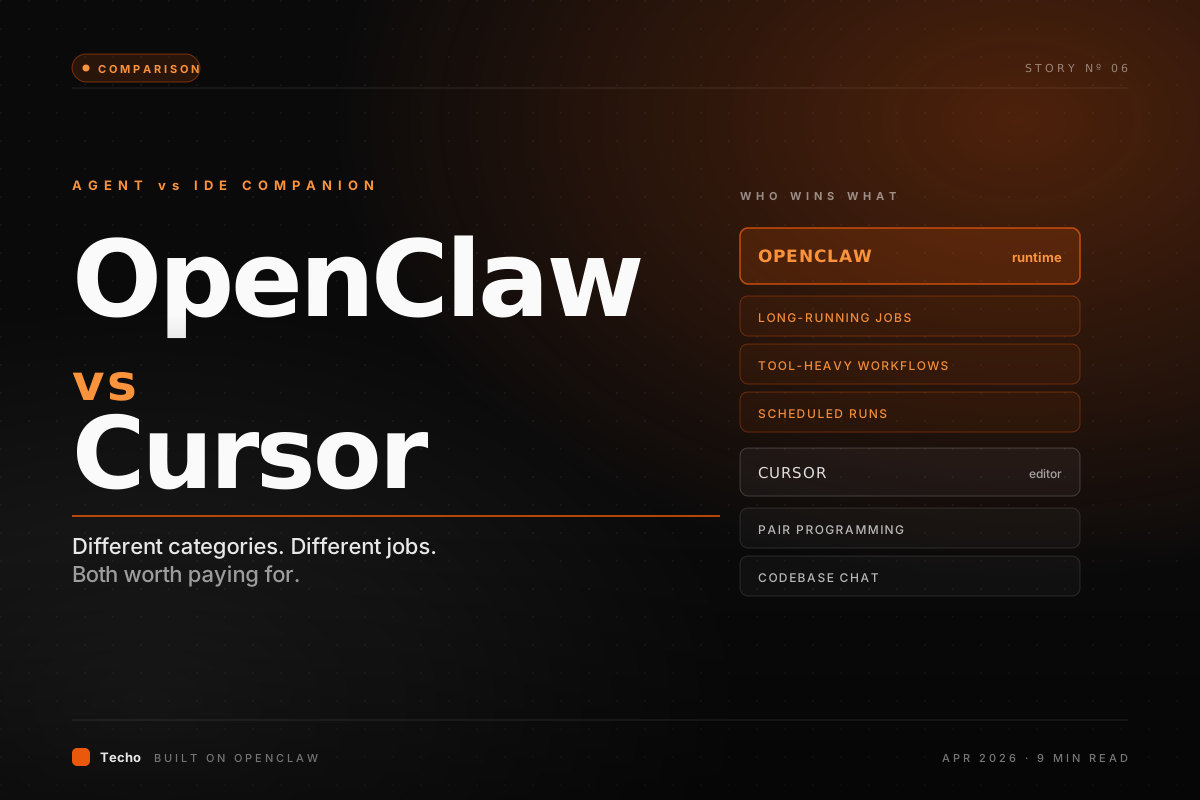
What OpenClaw is is an agent engine: an opinionated runtime that gives a developer the standard pieces of an autonomous agent in one place, the way a web framework gives you routing, sessions, and middleware in one place. The point is that you stop assembling boilerplate and start shipping behaviour. For the side-by-side against the popular pair-coder category, our piece on OpenClaw vs Cursor is the cleanest read.
02The four pieces inside the engine
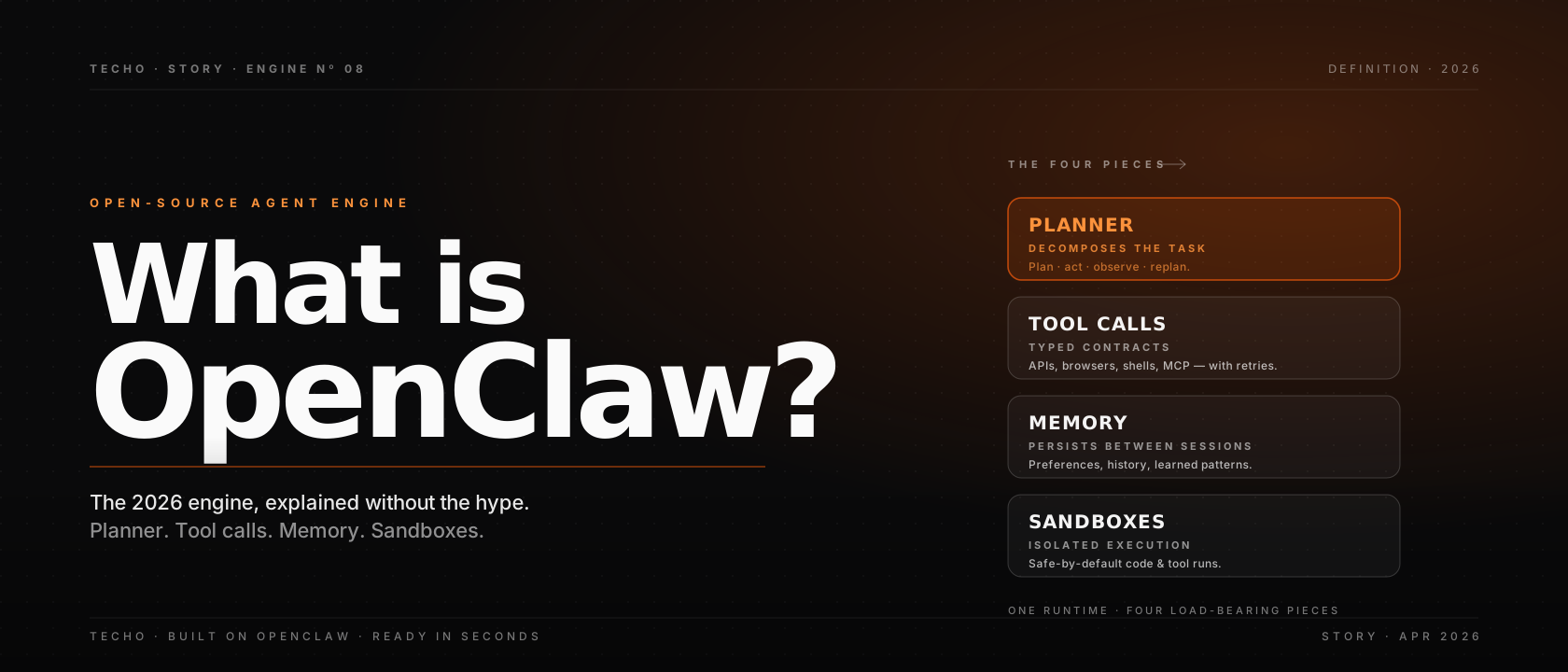
The mental model that holds up over time is to think of OpenClaw as four concentric capabilities.
1. Planner
The loop that turns a goal into a sequence of steps. It decomposes the task, picks the right tool for each step, and revises the plan when reality disagrees with the model. Without it, an agent is a single prompt; with it, an agent has a strategy.
2. Tool calls
A first-class interface for letting the agent act on the world — APIs, browsers, databases, shells, internal systems. OpenClaw treats tools as typed contracts with retries, fallbacks, and traces, not as ad-hoc strings glued into a prompt.
3. Memory
A persistent store that survives restarts, so the agent remembers your preferences, prior runs, and learned patterns. Memory is what lets the second run of a job be shorter than the first, and what gives an agent the feeling of continuity rather than amnesia.
4. Sandboxes
Isolated execution environments for code and tool use, so an agent that goes off-piste cannot harm the host or leak credentials sideways. Sandboxes are the boring, load-bearing piece that makes the rest of the engine safe to point at production.
Around those four sit the operational pieces every team eventually needs: an MCP registry for tool discovery, a model router so the right model is used per step, observability with structured traces, quotas, and a permission model. The four-piece core is what makes the rest possible.
03What OpenClaw is not
Three quick clarifications, because each one comes up in nearly every conversation about OpenClaw.
It is not a hosted service. The open-source project is a runtime you install. You can run it on a laptop, on a server, or inside your private cloud. Hosted versions exist on top of the engine — that is what products like Techo are — but the engine itself is code you can pin and audit.
It is not a closed ecosystem. OpenClaw is deliberately model-agnostic, tool-agnostic, and front-end-agnostic. You bring the model, the tools, and the interface; the engine wires the loop. That is why the same runtime turns up under a personal AI concierge, an internal ops agent, and a developer pair-coder without contortion.
It is not finished. Open agent runtimes are still moving fast. The shape of OpenClaw in 2026 is mature enough to put in front of customers, and the surface that matters — planner, tools, memory, sandboxes — is now stable. The patterns around it are still being written. That is normal for software in this part of its life.
04Why the engine exists
OpenClaw exists because building a serious agent without an engine is expensive and unstable in identical ways across every team that tries.
The pattern is by now well documented. A team starts with an LLM API, ships a chat surface, then realises the product needs to do something rather than just answer. They add tool calls, then realise calls fail and bolt on retries. They realise context is lost across sessions and add a memory store. They realise unsafe tool use can leak data and add sandboxes. By the time the agent is good enough for paying customers, the team has rebuilt OpenClaw badly.
Open-source runtimes take that bill of materials and ship it as one product. The engineering capital that used to go into glue code goes into the agent's behaviour instead. Our piece on OpenClaw vs Claude Code walks through the practical edges of this trade-off in a developer context.
05Where OpenClaw fits in your stack
The simplest way to picture OpenClaw is as the runtime layer between your model and your real systems. The model thinks; OpenClaw acts; your APIs, databases, and tools get the work done; observability records what happened.
That positioning is why OpenClaw shows up under products that look very different on the surface. A consumer AI concierge that books restaurants, an internal agent that triages support tickets, and a research agent that drafts a market scan all map onto the same loop with different tools and memory shapes. The differentiator is not the engine; it is what you wire to it and how you scope it.
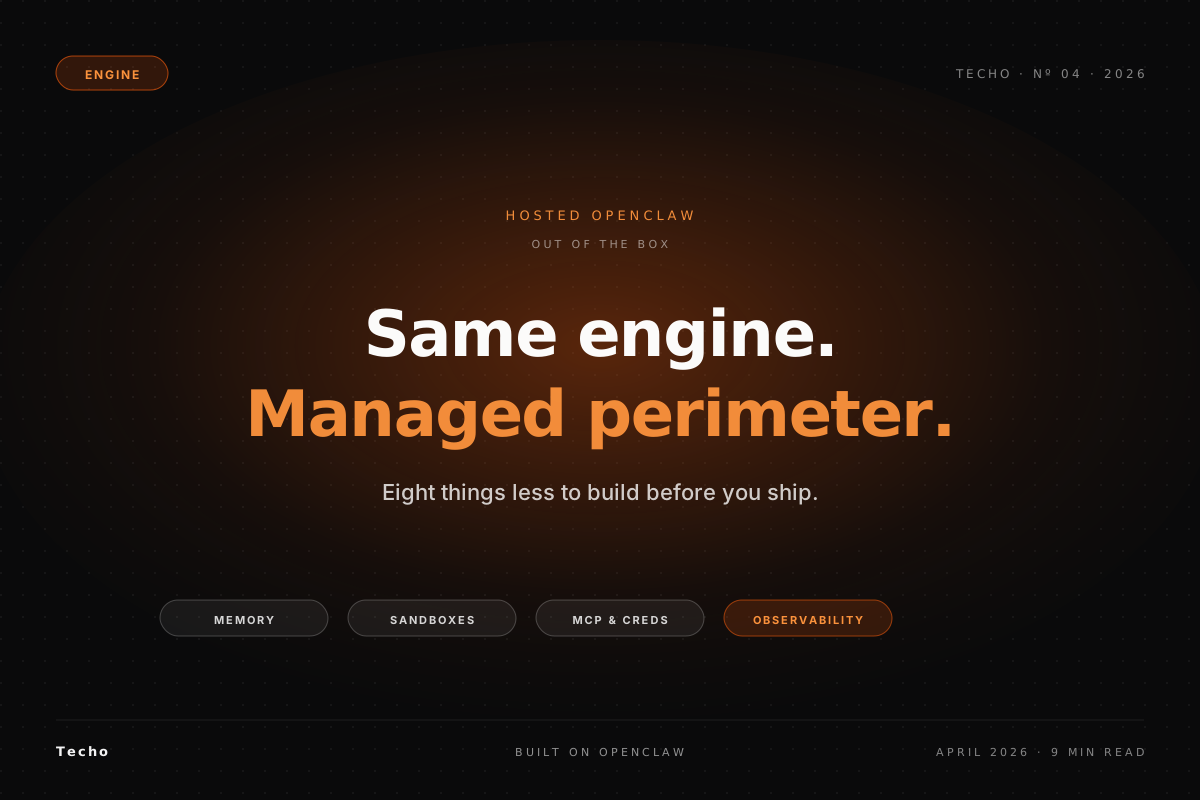
Self-hosting OpenClaw is the right answer when you have a strong platform team, sensitive data, or a need to pin specific versions. Hosted OpenClaw is the right answer when you would rather skip the platform sprint entirely and use the time on product work. Both are legitimate; the choice depends on where your team's leverage actually is. Techo as OpenClaw hosting walks through what the managed perimeter buys you in detail.
06The first useful agent you can build
If you want a concrete picture of what OpenClaw makes easy, picture the smallest agent that is genuinely useful: a Monday-morning operations digest.
The job runs every Monday at seven. It reads the previous week's GitHub activity through a tool, summarises it with the model, posts the summary to a Slack channel, and emails a one-pager to the founders. It remembers which pull requests you flagged last week, so it does not surface them again. If a tool call fails, it retries with backoff and pings a human if retries fail. The whole job leaves a structured trace you can replay.
None of those capabilities are exotic on their own; together, they are the difference between a one-shot prompt and a piece of operations infrastructure. OpenClaw provides them out of the box, and the agent that takes a fortnight to assemble from scratch becomes a configuration file plus a prompt.
☰Cheatsheet: OpenClaw in one table
One scannable grid for keeping the categories straight:
| Question | Answer |
|---|---|
| Category | Open-source agent engine |
| Surface area | Planner · tool calls · memory · sandboxes |
| Model | Bring your own; routes between frontier providers |
| Interface | Bring your own; chat, voice, dashboard, scheduled job |
| Tools | Anything addressable via MCP, HTTP, or shell |
| Memory | Persistent across sessions, scoped per user / agent |
| Safety | Sandboxed execution, observable traces, permissioned tools |
| License | Open source — pin, fork, audit |
| Cost shape | Engine free; pay for model usage and operations |
| Best fit | Tasks with steps, tools, and memory |
?FAQ
Is OpenClaw a chatbot?
No. A chatbot answers questions inside a single conversation. OpenClaw is an agent engine: it plans a multi-step job, calls real tools, persists memory between sessions, runs inside a sandbox, and is designed to finish tasks rather than reply with text. A chatbot can be a thin layer on top of OpenClaw, but the engine itself is the runtime, not the interface.
Is OpenClaw a model?
No. OpenClaw is model-agnostic. It works with frontier models from major providers and routes between them based on the job at hand. Think of OpenClaw as the runtime around the model rather than the model itself; swapping the underlying model is a configuration change, not a rewrite.
Is OpenClaw open source?
Yes. OpenClaw is open source. You can self-host it on your own infrastructure, fork it, audit it, and pin a version. Most teams that go to production end up wanting a managed perimeter around the engine, which is what hosted OpenClaw products like Techo provide on top of the open-source core.
What can you build with OpenClaw?
Anything that benefits from an autonomous, tool-using runtime: AI concierges, support agents, content pipelines, research agents, scheduled jobs, customer-facing assistants, internal ops bots. The shape of a good OpenClaw use case is a job that has more than one step, calls more than one tool, and benefits from remembering what happened last time.
How is OpenClaw different from LangGraph or AutoGPT?
OpenClaw, LangGraph and AutoGPT all sit in the same broad space, but the design centres differ. AutoGPT pioneered the idea of a self-prompting agent loop. LangGraph treats agent flow as an explicit graph the developer composes. OpenClaw is closer to a managed runtime: planner, tool calls, memory store, sandboxes, and observability arrive as one cohesive engine, with fewer assembly decisions to make.
Do I need to be a developer to use OpenClaw?
To self-host the open-source engine, yes. Standing up the runtime, wiring memory, setting up sandboxes, registering MCP tools and adding observability is a serious platform sprint. Productised versions of OpenClaw — Techo being one example — are aimed at non-developers: same engine underneath, with the operations layer and a user interface already in place.
§Where Techo fits
Techo is built on OpenClaw. It is a productised, ready-to-use OpenClaw aimed at end users who want a personal AI concierge without first setting up a runtime. The planner, tool-call interface, memory store, and sandbox model are the same OpenClaw the open-source project ships; what Techo adds is the operations layer (managed memory, sandboxes, MCP registry, model routing, observability, scheduled tasks) and a user interface.
If you are evaluating OpenClaw as the runtime for your own product, the open-source repository is the place to start; if you would rather shorten the path from runtime to product, hosted OpenClaw via Techo compresses the platform sprint into a subscription. Either way, the engine is the same.
OpenClaw is the body around the model. Without it, an agent is a prompt with a chat window; with it, an agent is a piece of infrastructure that does the work.
The right way to think about OpenClaw in 2026 is the way the industry came to think about web frameworks fifteen years ago: not glamorous, not where the breakthroughs are, but the layer that decides whether the product on top is shippable. Once you know what the engine does, the rest of the conversation gets a lot simpler.