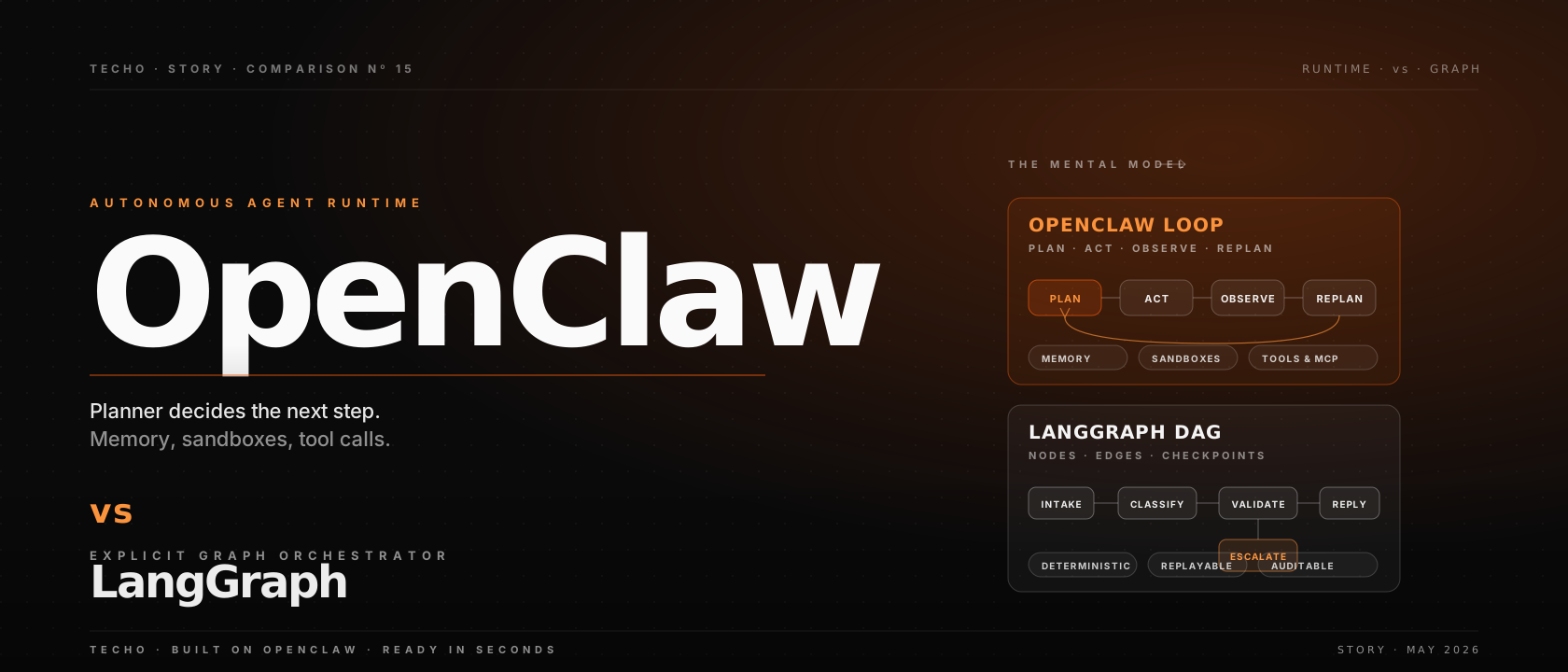
OpenClaw and LangGraph keep showing up on the same shortlist, which is misleading. They sit in different layers of the agent stack. OpenClaw is an autonomous runtime that decides the next step on the fly; LangGraph is an orchestration library that asks you to describe the steps upfront. Both are credible 2026 choices, both have honest weaknesses, and the right pick depends on whether the path through your task is mostly known or mostly discovered. This piece compares them on the dimensions that actually decide the answer.
The 60-second version
Pick LangGraph when the workflow has named stages, branches you can draw, and replay matters as much as the answer. Pick OpenClaw when the agent needs durable memory, sandboxes, tool calls and a planner that chooses the next step at runtime. They are complementary in production: a LangGraph outer loop with one or two OpenClaw nodes inside it is a normal shape. Cost favours LangGraph per task; engineering effort favours OpenClaw on open-ended work. Choose by the shape of the job, not by team religion.
01Why this comparison keeps coming up
The shortlist for an agent project in 2026 usually contains four names: OpenClaw, LangGraph, a hosted incumbent such as Claude Code or ChatGPT Agent, and an in-house orchestrator the team has been quietly maintaining. OpenClaw and LangGraph appear together because both are open, both are credible at production scale, and both leave the model-of-the-moment decision to you. The misleading bit is that they answer different questions. OpenClaw answers "how do I run an autonomous agent reliably?" and LangGraph answers "how do I orchestrate a long-running workflow that calls a model?". Treating them as substitutes leads to bad picks in both directions, so the first job is to separate the layers cleanly.
02The philosophical split
OpenClaw is shaped around an agent loop: a planner proposes a step, the runtime executes the tool call, an observer feeds the result back, and the planner decides what happens next. The graph is implicit, drawn in real time by the model and constrained by the tool schemas you allow. This is the right shape when the path through the task is genuinely unknown until the agent is partway through it.
LangGraph is shaped around an explicit state machine. You write nodes and edges; you decide which transitions are allowed; the controller walks them deterministically. The graph is the documentation, the audit trail and the runtime, all at once. This is the right shape when you can describe the workflow on a whiteboard before any model writes a token, and when "what happened in step three" needs an answer in a postmortem two months later.
Both philosophies are legitimate. The mistake is dressing one as the other.
03What OpenClaw looks like in production
An OpenClaw deployment has four load-bearing pieces, none of which a workflow library would expose first-class. There is the planner, which interprets the goal and chooses the next tool call. There is the memory layer, which persists facts between sessions so the agent does not start cold every morning. There are the sandboxes that isolate file, browser and shell tools so a misbehaving step cannot exfiltrate data. And there is the tool catalogue, including MCP integrations, that defines what the agent is allowed to touch.
The shape feels like running a small operating system rather than a function call. You think about quotas, traces, retries and confirmation policies. The reward is that an OpenClaw agent can carry a goal across days and tools without you stitching the pieces yourself. For the foundations of that runtime, see the 2026 explanation of what OpenClaw is; for the cost surface specifically, the cost model breakdown covers the line items.
04What LangGraph looks like in production
A LangGraph deployment has a different vocabulary. You write a graph definition: a set of nodes, each a Python function, each producing a slice of state, with edges that route the state forward based on conditions. The runtime walks the graph, persists checkpoints, and resumes from any node when something fails. Tools and model calls are nodes like any other, which means they sit beside parsers, validators, branching logic and human-approval gates without ceremony.
The shape feels like an orchestration framework you might recognise from data pipelines, with a model in one or more nodes. The reward is total observability of every transition: you can replay the same input and watch the same path, debug a single node in isolation, and reason about behaviour the way you reason about a workflow engine. The price is that you write the graph; the framework does not invent it for you.
05Where LangGraph genuinely wins
Three families of work favour LangGraph cleanly. The first is regulated workflows where every transition needs to be auditable: insurance triage, KYC checks, content moderation pipelines, anything where "what step did we take and why" must answer in court. The explicit graph is the documentation, and replay is built in.
The second is multi-stage document processing. Intake, OCR, classification, validation, enrichment, output: you can draw it on a napkin, and turning the napkin into a graph is a one-day exercise. An autonomous agent will solve the same problem at higher cost and lower predictability.
The third is teams that have already invested in graph thinking. If the engineers are comfortable with state machines, prefer deterministic control flow, and want to hold the model to a strict contract, LangGraph plays to those instincts. The framework lets a careful team compose careful systems. None of this is a knock on OpenClaw; it is just that the shape of the problem matches the shape of the tool.
06Where OpenClaw genuinely wins
OpenClaw wins where the path is discovered, not declared. Research agents that follow leads, personal-ops agents that manage life admin, content agents that fact-check across the open web, on-call agents that triage alerts: in each case, the next step depends on what the previous step learned. Encoding every branch upfront would either explode the graph or fail to anticipate the long tail. A planner-act-observe loop carries that uncertainty more honestly.
The second OpenClaw advantage is durable memory. Persisting context between sessions, learning from corrections and reusing facts across tasks is a first-class feature, not a node you have to implement. For long-running personal or back-office agents this is decisive: you want yesterday's progress to inform today's decisions without rehydrating state by hand.
The third advantage is safety machinery. Sandboxes, tool confirmations and human-in-the-loop checks are part of the runtime, not glued on later. Reading the practical comparison with another autonomous tool — see OpenClaw vs Claude Code — makes the same point from a different angle.
07Tooling, debugging and observability
Both projects ship serious observability, but they spell it differently. LangGraph gives you per-node traces, deterministic replay and a checkpoint store; you can pause execution at any node, inspect state, and restart from there. The mental model is the one you already use for backend workflows, which makes onboarding faster for engineers with a data-pipelines background.
OpenClaw gives you per-step traces of the planner-act-observe loop, sandbox audit logs, and tool-call schemas you can search and filter. The mental model is closer to operating an autonomous service: you watch the agent's decisions, look at the tool inputs and outputs, and intervene when the loop drifts. Both are workable; both require investment to get right. The honest difference is that LangGraph debugging is closer to debugging a workflow, and OpenClaw debugging is closer to debugging an operator.
If you take observability seriously enough that you want it included in the bill, hosting matters as much as the framework — the next section covers that.
08Hosting, ops and the bill
LangGraph deployments tend to live where your data pipelines live: a Python service behind your existing observability stack, with a checkpoint store on Postgres or Redis. The ops surface is familiar, and the framework leaves the deployment shape to you. That is a feature for teams with a strong platform; it is a tax for teams that do not have one.
OpenClaw deployments are larger by default: a runtime, a memory store, a sandbox layer, a tool gateway, and the model billing on top. Self-hosting is doable — the self-hosting OpenClaw piece walks through the failure modes — but most teams pay for managed hosting because the operational perimeter is the slow part. Techo's OpenClaw hosting bundles memory, sandboxes, observability and a single bill, which removes the four ops projects you would otherwise schedule. On per-task cost, LangGraph wins because the path is constrained; on engineering hours, OpenClaw wins on open-ended work because the runtime carries what would otherwise be code.
09The boring answer: use both
The most common production pattern in 2026 is a mix. The outer loop is a LangGraph workflow with named stages — intake, classification, action, escalation, reply — because the team needs the audit trail and the explicit branches. Inside one or two stages, an OpenClaw agent does the open-ended work: drafting a long answer, running a research mini-loop, taking a multi-step action against an external service. The seam is one explicit node in the graph that calls the agent, captures the result, and continues.
This pattern keeps the determinism where it matters and the autonomy where it pays off. It also avoids two failure modes: the over-rigid LangGraph that breaks on the first edge case the workflow author did not anticipate, and the over-autonomous OpenClaw deployment that drifts in places where a state machine would have been clearer. If your team is small, start with whichever framework matches your dominant problem shape, and add the other one only when a real production stage demands it.
10Cheatsheet, FAQ and the Techo angle
One grid to settle the choice in a meeting. Match the row to your task and pick the framework with the green tick.
| Dimension | OpenClaw | LangGraph |
|---|---|---|
| Path is mostly discovered | Strong fit | Awkward |
| Path is mostly declared | Overkill | Strong fit |
| Durable cross-session memory | Built in | Roll your own |
| Sandboxes & tool gateway | First-class | External concern |
| Per-node replay & audit | Possible | Native |
| Per-task cost | Higher | Lower |
| Engineering hours on open-ended work | Lower | Higher |
| Familiar to data-pipeline teams | New mental model | Comfortable |
| Suits regulated workflows | Possible with care | Native shape |
| Suits autonomous personal & ops agents | Native shape | Possible with care |
Frequently asked questions
What is the core difference between OpenClaw and LangGraph? OpenClaw is an autonomous agent runtime that decides the next step at runtime; LangGraph is an explicit orchestration library where you draw the graph upfront. Different layers of the same stack, not substitutes.
When should I pick LangGraph over OpenClaw? When the task is a workflow with named stages and clear branches, when audit and replay matter, and when the model is one component inside a longer pipeline.
When should I pick OpenClaw over LangGraph? When the path is discovered at runtime, when memory and sandboxes are first-class concerns, and when the planner should choose the next step rather than encode it ahead of time.
Can I run both in the same product? Yes. A LangGraph outer loop with one or two OpenClaw agent nodes inside specific stages is a common production pattern.
Which is cheaper to run? LangGraph wins per task because the path is constrained; OpenClaw saves engineering hours on open-ended work because the runtime carries the state machine you would otherwise have to build.
Where Techo fits
Techo is a productised, ready-to-use OpenClaw — built on OpenClaw with the integrations, fallbacks and human-in-the-loop checks that turn the runtime into a product. If you decide OpenClaw is the right fit for an autonomous agent and you do not want to operate the perimeter yourself, hosted OpenClaw on Techo bundles memory, sandboxes, observability and the model bill into one subscription. If LangGraph is the better fit for your workflow, that is a fine answer too — the framing of this comparison was never about replacing it. For more on the hosted side, see Techo's OpenClaw hosting overview.