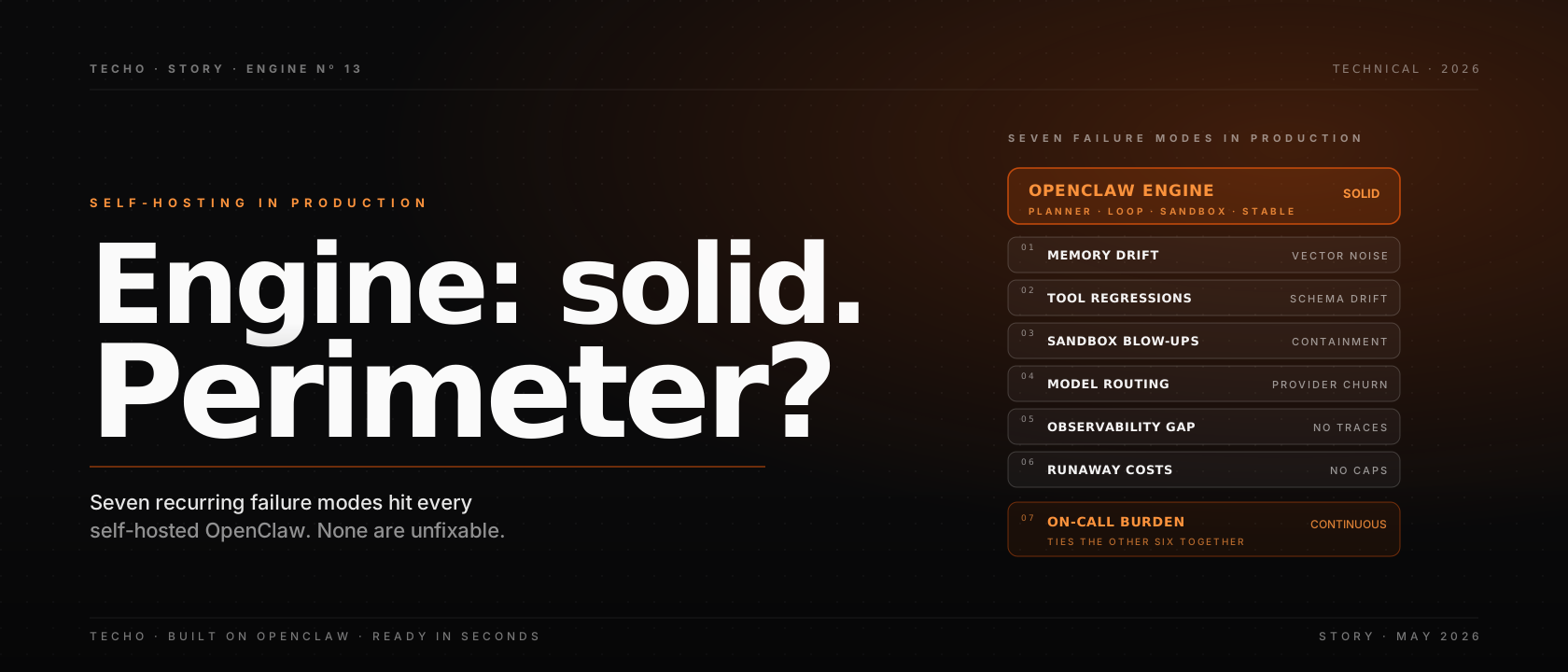
Self-hosting OpenClaw is not the hard part. Keeping a self-hosted OpenClaw agent healthy in production is. The engine itself behaves; the trouble starts at the perimeter, where schemas drift, providers move, vector stores accumulate junk, and a quietly broken agent looks identical to a healthy one until somebody reads the traces. This is a calm walk through the seven failure modes that hit nearly every self-hosted OpenClaw deployment, and where the operator-time bill really lands.
§The short answer
The aim here is not to talk anyone out of self-hosting; some workloads belong on a self-hosted perimeter and always will. The aim is to put shapes on the operator-time line that does not appear on the engine’s pricing page.
01The shape of self-hosted OpenClaw on day one
Day one looks deceptively clean. Pull the engine, point it at an LLM provider, register a few tools, configure a vector store for memory, wrap the planner in an HTTP service, and ship a thin frontend. A capable engineer can have a useful agent running inside an afternoon. The piece on what is OpenClaw covers the engine’s anatomy if a refresher helps.
That day-one setup is not the production system. It is the demo. Production starts when the agent runs unattended, when more than one person depends on it, and when the data the planner remembers begins to matter. Self-hosted OpenClaw behaves like a small internal SaaS, not a library: written once, operated forever.
02Memory drift: vector stores never stay quiet
Memory is the first surface to misbehave. The planner writes embeddings on every interesting turn; the retrieval layer pulls a few back on every new task. In a healthy agent that produces continuity. In a neglected one it produces noise that the planner trusts.
Three drift patterns recur. Stale facts: an old preference (“book the Marriott”) that contradicts a newer one. Embedding incompatibility: a model upgrade changes the vector space and silently degrades retrieval until the index is rebuilt. Cardinality bloat: hundreds of near-duplicate memories drowning the relevant one.
The fix is hygiene, not cleverness: deduplication on a schedule, retention that ages out memories nobody has touched in a quarter, and an embedding-version pin that triggers a rebuild when the upstream model changes. None is difficult; it is just one more thing nobody owns until the agent acts on out-of-date context.
03Tool-schema regressions: schemas age faster than handlers
Tools are the second surface. Each registered tool is a typed contract: a name, an input schema, and a handler. The planner reads the schema to decide when to call the tool, which arguments to pass, and how to interpret the result. The handler runs the actual work. Schemas drift faster than handlers in production for the same reason API contracts drift: vendors update them.
A typical incident: a calendar provider deprecates the start_time argument in favour of start, returns a new error code, and tightens validation on a previously optional field. The handler keeps compiling. The planner keeps choosing the tool. Calls fail intermittently or, worse, succeed with partial arguments. Nothing in the logs screams; the symptom is a drop in success rate that takes a week to notice.
Catching this needs a habit, not a feature: a tool-schema sweep on a fixed cadence, contract tests that exercise each handler against the live API, and an alert when a third-party schema diverges from the one the agent was registered with. The piece on OpenClaw vs Claude Code contrasts how managed and unmanaged tool surfaces age over time.
04Sandbox blow-ups: when the agent gets exactly what it asked for
OpenClaw sandboxes are deliberately powerful: the agent can run shell commands, browse, write to a workspace, and execute code in an isolated environment. That power is the point, and also what makes the sandbox the third failure surface. Most incidents are not security breaches but containment failures: a process that never exits, a runaway loop, a download that fills the disk, a browser session that wedges.
1. Process runaway
An agent kicks off a script that loops on a recoverable error. Without a wall-clock cap, it runs until something else breaks.
2. Disk exhaustion
A logging or download step writes faster than retention prunes. The volume fills, every subsequent task fails to start.
3. Memory creep
A long-lived sandbox accumulates state across tasks. Eventually the OOM killer takes it down at the worst moment.
4. Network blast radius
A misconfigured egress allows the sandbox to reach an internal endpoint nobody intended. Quiet, until somebody audits.
None are exotic. They are the ordinary chores of any executor service, scaled up because an agent generates work autonomously rather than from a queue. The mitigation menu is well-known: per-task wall-clock and memory budgets, egress allowlists, ephemeral filesystems, and a kill switch that surfaces in chat. The work is doing it consistently across every sandbox the agent ever instantiates.
05Model-routing churn: providers move, prices move, models retire
Model routing is the fourth surface, and the one most likely to surprise a self-hoster. The model catalogue under an OpenClaw setup is rarely a single model. It is a policy: a small fast model for planning, a stronger model for synthesis, a vision-capable model for screenshots, perhaps a cheap embedding model for memory and a separate one for retrieval re-ranking. That policy lives in configuration files and code paths.
Providers move. Models are deprecated on three- to nine-month timelines, prices drift, rate limits change, and refusal behaviour tightens with each generation. The piece on OpenClaw cost model walks through the routing line on a typical bill. Self-hosters absorb each change manually: re-pin the model, re-tune the planner, re-validate cost, and re-run the regression tests that measure quality. Without that discipline, routing decays into a brittle pile of overrides. Hosted OpenClaw absorbs the churn into the subscription; the routing policy moves underneath and the surface stays the same.
06Observability blind spots: no traces, no diagnosis
The fifth surface is observability. An agent without traces is a system the operator cannot debug. Self-hosted OpenClaw ships hooks for logging every planner step, tool call and model exchange; using them well is what separates a maintainable agent from a black box.
Three layers earn their keep. Structured logs with consistent run IDs let an operator follow a task from request to outcome. Trace trees join those records into a hierarchy per task, surfacing where time and tokens went. Metrics on top — latency, retry rates, tool errors, sandbox refusals, per-task spend — give the early-warning signal before customers notice anything wrong.
Most self-hosted setups bolt on observability after the first painful debugging session: incident, panicked grep, vow to do better, partial rollout, new gap a quarter later. Observability is the surface where a managed perimeter pays off fastest. The piece on Techo as OpenClaw hosting covers what arrives pre-wired in the hosted version.
07Quotas and runaway costs: the bill nobody set a cap on
The sixth surface is the one that gets attention only when an invoice arrives. Agents do not hold themselves back. Without explicit per-task and per-tenant budgets, a single retry loop or an overly eager planner can multiply token consumption tenfold inside an afternoon. The OpenClaw engine exposes the hooks; the ceilings have to be set by the operator.
The recurring patterns repeat. A planner gets stuck in a recovery loop and burns tokens until somebody notices. A new tool returns large payloads that get embedded and re-embedded. A scheduled job fans out across thousands of records before anyone notices the cron was misconfigured. Each incident is small; together they build the “why is the bill bigger this month?” conversation. The fix is policy: hard wall-clock and token caps per task, per-tenant rate limits, a daily spend ceiling that refuses by default, and dashboards that surface the top spenders.
☰Cheatsheet: seven failure modes in one table
A scannable grid for the next planning meeting:
| Failure mode | Symptom | Owner work |
|---|---|---|
| Memory drift | Stale or contradictory recall | Dedup, retention, embedding rebuilds |
| Tool-schema regression | Quiet drop in success rate | Contract tests, scheduled sweeps |
| Sandbox blow-up | Runaway processes, full disks | Per-task budgets, egress allowlists |
| Model-routing churn | Tone or cost shifts overnight | Re-pin, re-tune, regression tests |
| Observability gap | Long debugging sessions | Structured logs, traces, metrics |
| Runaway costs | Surprise invoice line | Caps per task, per tenant, per day |
| On-call burden | Platform crowds out workload | Dedicated rota or hosted perimeter |
?FAQ
Is OpenClaw stable enough to self-host in production?
The engine itself is stable: the planner, the tool-call loop and the sandbox primitives all behave reliably under normal load. What is less stable is the perimeter around the engine. Tool schemas drift, model providers retire endpoints, vector stores accumulate noise, and observability gaps surface late. Self-host succeeds when a team budgets for that perimeter as ongoing work, not a one-off setup.
What are the most common OpenClaw self-hosting failures?
Seven recurring patterns: vector-store memory drift, tool-schema regressions, sandbox blow-ups when the agent gets unexpected access, model-routing churn after provider changes, observability blind spots that make debugging slow, runaway costs from quotas that nobody set, and the on-call burden that ties to all of the above. None are unfixable; they just need someone watching.
How much operator time does self-hosted OpenClaw actually need each month?
For a single small agent, expect roughly half a day a week of attention once the platform is stable: a tool-schema sweep, a memory pass, a model-routing review, a quota review, and a quick look at traces. Multi-agent fleets scale that to one to two days a week per engineer involved. Spikes happen when providers retire endpoints or tool vendors push breaking changes.
Should I self-host OpenClaw or use a hosted version?
Self-host when data residency, model pinning or topology control are hard requirements, and when you have engineering bandwidth to run the perimeter as ongoing work. Hosted OpenClaw fits when the workload is the priority and the platform is overhead. Most teams that begin with self-hosting eventually adopt a hybrid: hosted for everyday agents, self-hosted only where compliance forces the choice.
How do you monitor and debug a self-hosted OpenClaw agent in production?
Three layers. First, structured logs of every planner step, tool call, model exchange and sandbox action with consistent run IDs. Second, traces that join those records into a tree per task so you can replay decisions. Third, metrics for latency, retries, tool-error rates, sandbox refusals and per-task spend. Without all three, debugging an agent becomes guessing.
What changes when OpenClaw updates a tool schema or model routing?
Two surfaces in your perimeter shift at once. Tool handlers must match the new schema, otherwise calls quietly fail or pass through partial arguments. Routing config must adapt to a new provider catalogue, otherwise the agent falls back to a model with different cost, latency or refusal behaviour. Hosted OpenClaw absorbs both updates; self-hosters do them on their own clock.
§Where Techo fits
Techo is built on OpenClaw. The engine inside is the same open-source runtime a self-hoster would otherwise stand up themselves; the difference is the perimeter. Memory hygiene, tool-schema sweeps, sandbox budgets, model routing, observability and quotas are wired up by default and maintained by the people who maintain the platform. The seven failure modes above still exist underneath; they are just somebody else’s job.
For a team weighing whether self-hosting is right, the practical question is rarely “can we run the engine?”. It is “is the perimeter the work we want to do?”. If the answer is no, hosted OpenClaw via Techo is the shortcut: same engine, managed perimeter, predictable bill, and an on-call human absorbed into the subscription rather than added to the rota.
The engine was always going to be the easy part. Whether self-hosting is worth it depends entirely on whether running its perimeter is the work the team wants to optimise for.
For organisations with hard residency or topology requirements, the perimeter is the work, and self-hosting is correct. For everyone else, hosted OpenClaw is the calmer route to the same outcome.